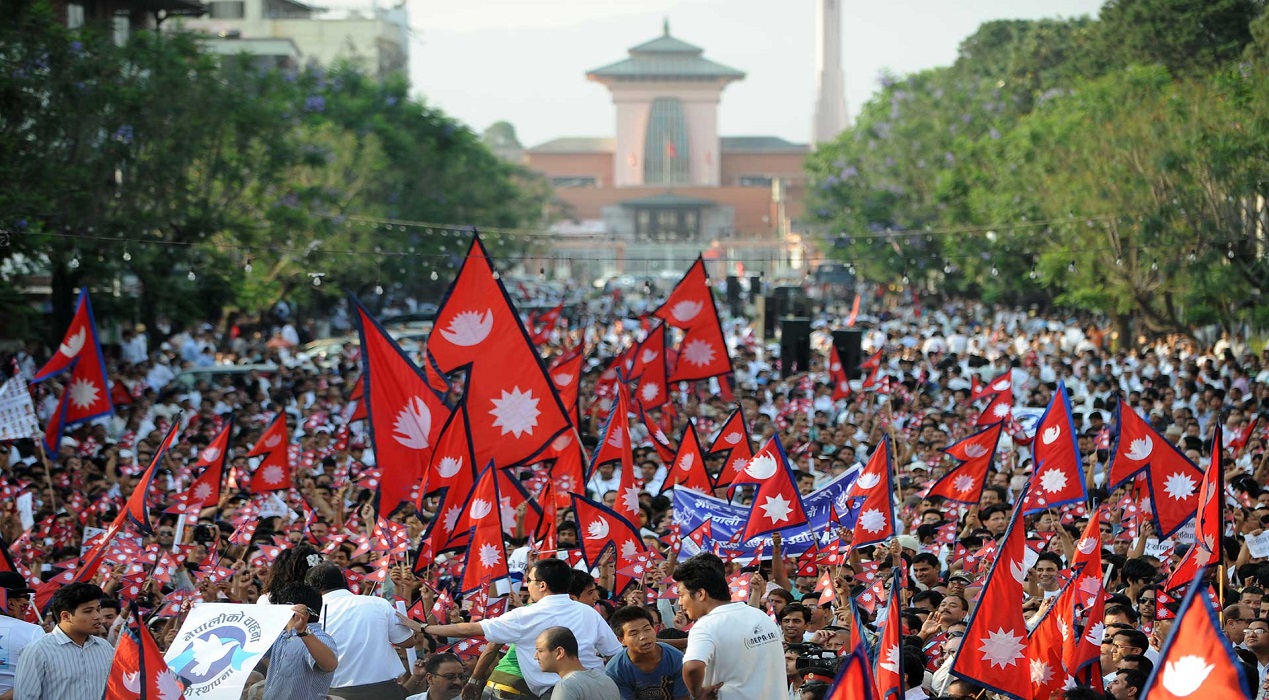
Another neighbour is on the verge of civil unrest as Nepal has lately witnessed a surge in pro-monarch uprising , where the protesters have been demanding to restore the former Nepal Nripati Gyanendra Shah in the historic Narayanhiti palace. The Himalayan nation woke up to a visible public gathering in front of Tribhuvan international airport on 9 March 2025 to welcome former king Gyanendra, who was returning to Kathmandu after paying a visit to many Hindu religious sites in western Nepal. Inspired by Shah’s declaration on the occasion of Nepal’s Democracy Day that he would play an active role in the politics, the pro-monarchy agitators set a real show of strength on 28 March, when the agitators organised a massive demonstration in the capital city of Nepal. The demonstration eventually turned violent and resulted in the killing of at least three persons, including a television journalist, who were seemingly burnt alive.
The protesters demanded to replace the current Nepal Republican Constitution (adopted in 2015) with the 1990 Constitution, which was promulgated by the then monarch Birendra Bir Bikram Shah. King Birendra and his family faced an unfortunate massacre in 2001, when the crown prince Dipendra mysteriously killed the royal family members including his father and even himself. After the infamous Narayanhiti palace massacre, the king’s brother Gyanendra Shah ascended the throne. King Gyanendra seized absolute power in 2005 after dissolving the Parliament. However he had to relinquish power following widespread armed Maoist protests erupted in 2006. Later in 2008, the Parliament abolished the 240 years of Hindu royal rule in Nepal and endorsed a secular federal democratic republic.
Gyanendra Shah left the palace and maintained a private life since the middle of 2008. Even though he was dethroned, Shah did not leave the country. Probably, he was waiting for an opportune moment and the political instability in the government, rampant corruption and public sufferings in daily life & living had given Shah and his followers the expected break. Besides the repeated failure of all political parties (including in the opposition), many indigenous Nepali citizens apprehend that the so-called secular regime was helping the Christian and Muslim preachers to increase their followers and thus creating a demographic imbalance in the country.
Nepal went to the last general elections in November 2022, where no political party got the necessary majority in the 275-member House of Representatives. Prime Minister Khadga Prasad Sharma Oli (who leads the Communist Party of Nepal-United Marxist-Leninist) now runs a coalition government with support from the Nepali Congress. Incidentally no government in Kathmandu has completed its full five-year term since the restoration of democracy in 1990. Repeated changes of governments (or the premiers) only promoted instability in the administration. The common people start thinking that the Nepali politicians are interested in their personal benefits only as they continue enjoying power in a rotational manner, but in no way they are sincere to public grievances (or common causes of welfare).
Incidentally PM Oli (occupying the post for the fourth time) and Nepali Congress president Sher Bahadur Deuba (waiting to occupy the PM post for sixth time) are scheduled to rotate in holding the coveted position till the next national elections in 2027. The pro-royalist Rastriya Prajatantra Party (RPP) denounced all the political entities and continued pursuing a Hindu kingdom bringing back Gyanendra Shah to the royal palace. The RPP leaders made public statements on a regular basis that their king was ousted in 2008 unceremoniously. The Hindu nationalist leaders argued that the monarchy always ensures a sense of pride, stability and unity for the Nepali people.
Meanwhile, the opposition Communist Party of Nepal-Maoist Centre (lead by three-time Nepal premier Pushpa Kamal Dahal alias Prachanda) also condemned the violence created by the pro-monarch agitators. Prachanda, who led the decade long (1996 to 2006) armed insurgency in Nepal, where over 16,000 people were killed, to successfully dethrone the monarchy, warned that any attempt to dilute the republican gains will not be accepted. He alleged that Gyanendra Shah was promoting pro-Hindutva forces which would threaten the secular fabric of Nepal. Needless to mention that, a hardcore saffron nationalist Adityanath publicly supported the reinstatement of Nepal’s Hindu identity.
Nepal slips into turmoil