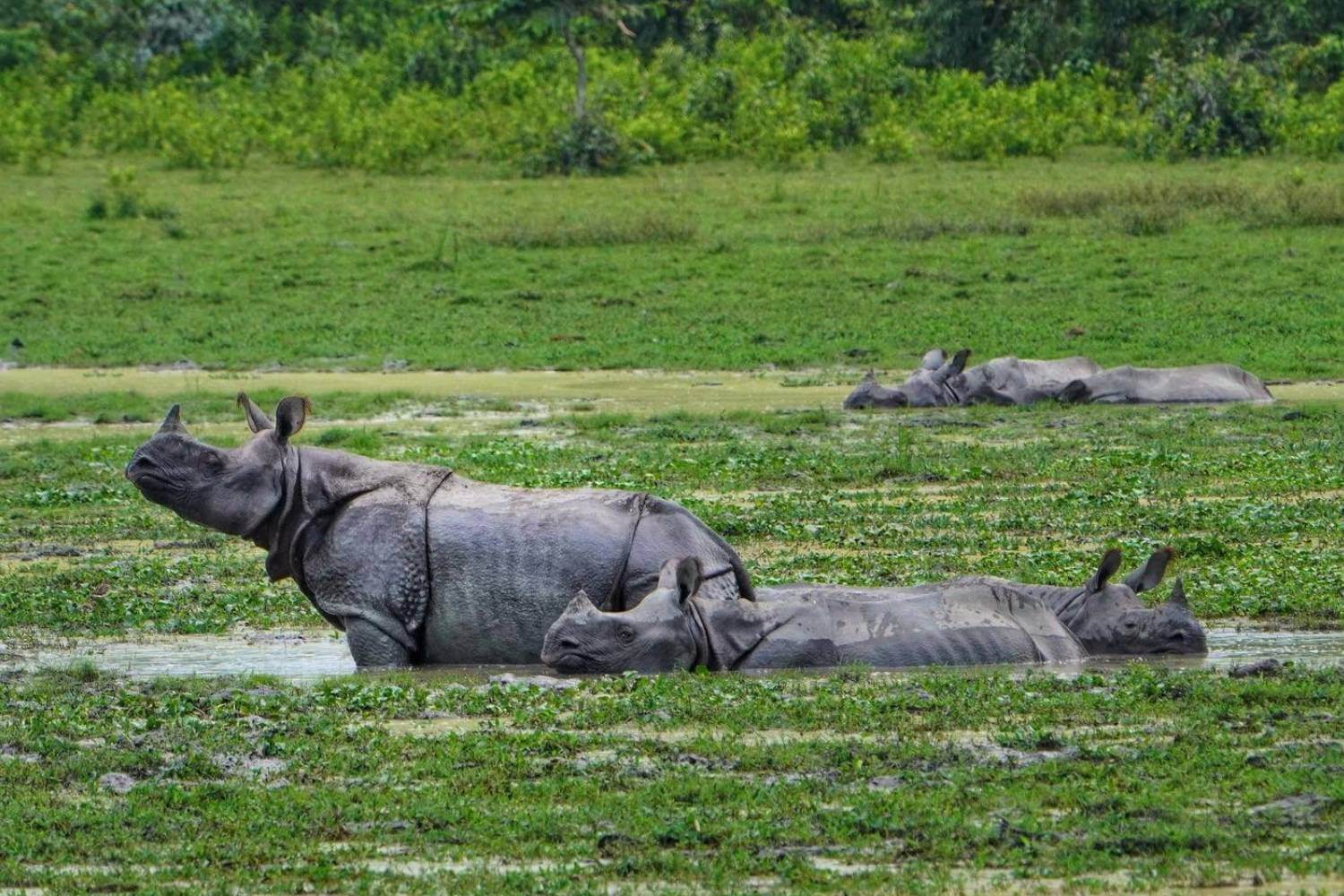
The conservation history of wildlife in Assam achieved another milestone last year with no-poaching of precious one-horned rhinoceros (also known as rhinoceros unicorns) in all forest reserves thanks to hard laws, efficient forest staff supported by Assam police and increased public awareness in the last few years. In fact, the State in eastern India, realized the record in 2022 as well for the first time since 1977, when the responsible agencies succeeded in preventing not even a single poaching of rhinos. Next year, one rhino was poached and two in 2024, following which the concerned authorities launched ‘Operation Falcon’, a multi-agency crackdown against the poachers across Assam to maintain the success story. The single horn rhinos, which are killed by poachers to take away the horn, believed to have aphrodisiac (traditional Viagra) value, which may fetch them a few hundreds of thousands of bounty in the illegal wildlife market. They have a significant population in Assam, more precisely in Kaziranga National Park & Tiger Reserve (KNPTR), an UNESCO world heritage site, which gives shelter to nearly 2,700 rhinos.
Assam chief minister Himanta Biswa Sarma recently went on explaining that no poaching incident took place in Kaziranga, home to two-third of the global single horn rhino population, for over 730 days (since February 2024 till date). The saffron leader claimed that the poaching of rhinos and other wildlife across the Assam forest reserves is drastically reduced due to various effective conservation efforts. He mentioned Operation Falcon, a joint anti-poaching initiative launched by Assam police and State forest department officials, which led to zero rhino killings in the last 24 months. No less than 42 poachers were arrested, six major poaching gangs dismantled and nine poaching attempts foiled under the operation that came to existence as two adult rhinos were poached inside Kaziranga during the second half of January 2024.
Prime Minister Narendra Modi appreciated the State government for preventing rhino killings in Kaziranga and other forest reserves in 2025 by strengthening wildlife protection and also promoting sustainable tourism in the region. PM Modi on 18 January 2026 performed Bhoomi Pujan for the Kaziranga elevated corridor project, which is termed as a landmark infrastructure initiative to ensure the wildlife safety against the movement of vehicles on the elevated National Highway-715 (formerly NH-37) through Kaziranga. The environment-friendly highway project (worth over Rs 6,950 crore) includes a 34.45-km elevated wildlife corridor, developing bypasses at Jakhalabandha and Bokakhat areas, and widening of the existing 86-kilometre highway from Kaliabor to Numaligarh to four lanes. Once completed the project, the vehicles will run above without disturbing the traditional wildlife movement (mostly used by rhinos, elephants, tigers, etc) below.
It is also expected to reduce killings of accidental deaths to wildlife while crossing the highway (precisely during night hours) and also enhance the road connectivity with the eastern Assam localities including some areas of Arunachal Pradesh (and beyond). Addressing a public rally on the occasion, PM Modi pointed out that Kaziranga is not just a national park but the soul of Assam and a priceless jewel of India’s biodiversity. Hence protecting Kaziranga and its wildlife is not only about safeguarding the environment but also a responsibility towards Assam’s future and coming generations. Modi, in the presence of Assam Governor Lakshman Prasad Acharya, CM Sarma, State forest minister Chandra Mohan Patowary, Union ministers Sarbananda Sonowal and Pabitra Margherita with other dignitaries, did not forget to recall the words of music maestro Bharat Ratna Bhupen Hazarika, who described Kaziranga’s beauty and elegance with deep affection and care.
KNPTR director Sonali Ghosh described the project as ‘designed to strike a balance between the demands of future growth and the need to protect the environment through conservation efforts’. She asserted that Kaziranga isn’t simply a protected area, but a safe haven for rhinos, tigers, elephants, wild buffalo, swamp deer and many such priced widlife. During the monsoon season, when a large section of the park becomes inundated due to high water levels, it prompts animals to move towards higher ground on Karbi Anglong hills in southern direction. During the movements, many animals fall prey to accidents caused by fast-moving vehicles on NH-715. Despite speed limits and warning signs, accidents continued for decades, demonstrating the need for a permanent and comprehensive solution. An improved highway aligning with the wildlife underpasses was thus the need of the hour, she added.
Scripting a success story in rhino conservation