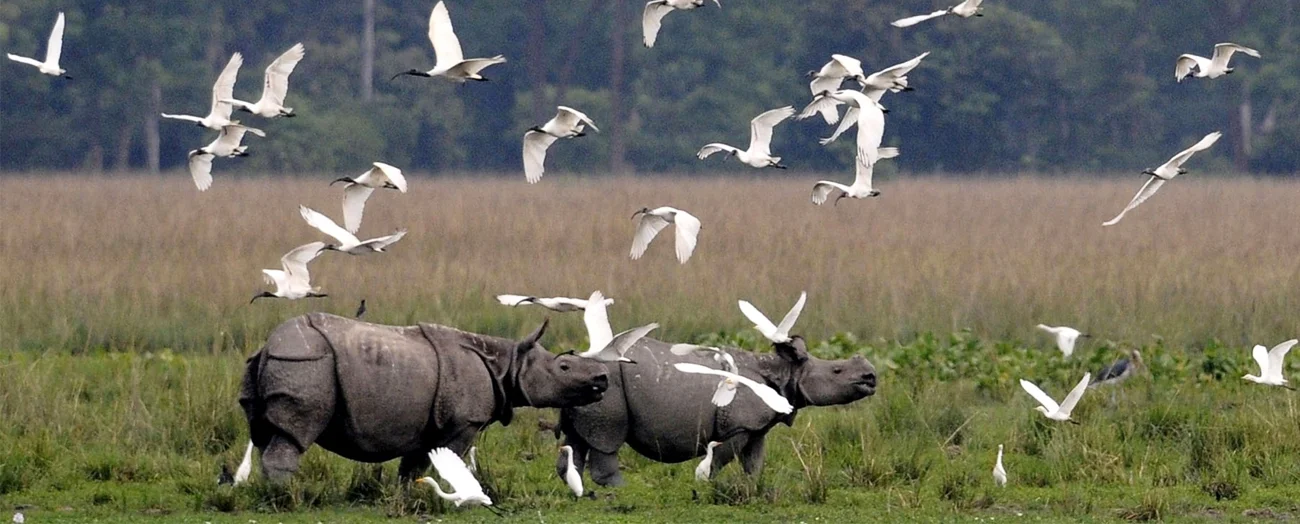
A debate gains momentum soon after Assam government initiated to notify a site-specific eco-sensitive zone (ESZ) around Kaziranga National Park and Tiger Reserve extending from one to three kilometers from the existing boundary. Even though the initiative complies with directives from the Supreme Court of India, the issue draws public attention following demonstrations by both the opposition parties and local supporters. The mandatory buffer zone around the protected areas usually restricts any major construction, urban expansion or mining activities as these interventions may worsen the human-wildlife conflicts. The opposition parties along with many environment enthusiasts strongly reacted to the government proposal for reducing the coverage areas than the default 10 km citing the reason that it would jeopardize the mission to protect the wildlife on various occasions. Assam Congress chief Gaurav Gogoi, while opposing the ESZ proposal, argued that a reduced buffer zone would deprive the wildlife of necessary protection.
However, Assam chief minister Himanta Biswa Sarma strongly defended the proposal to redraw the ESZ line around Kaziranga asserting that the government move complies with the apex court’s directives. The SC guidelines specify that the ESZ should be at least one km (from the boundary) and it may extend to three km depending on situations, said Sarma, adding no forest reserve across the world maintains a surrounding ESZ spreading to 10 km. He also argued that an ESZ does not mean ‘no tourism infrastructure’ but a primary guideline to regulate activities such as mining, chemical exercises and other polluting industries that may harm the ecological integrity of a protected area. Sarma reiterated that the Kaziranga boundary continues to exist with a 10 km buffer until the government officially notifies the ESZ limit.
Earlier, Assam BJP president Dilip Saikia also criticized the Congress party over its protest against the ESZ trimming, claiming that over 235 precious rhinos were killed during the tenure of the then Assam forest minister Rakibul Hussain. Saikia stated that the BJP-led governments in Dispur have brought down the number of rhino-poaching incidents drastically. He denounced the opposition for ‘politicizing the Kaziranga’s ESZ issue’ for probable electoral gains. Assam minister Pijush Hazarika also stated that the move (for notifying ESZ limit) would never dilute the initiative for environmental protection around Kaziranga. He asserted that the government favours a scientifically assessed site-specific ESZ of around 1-3 km, instead of mechanically applying a blanket 10-km buffer zone.
Incidentally some local residents also come out supporting the proposal for a site-specific buffer zone. They pointed out that the villages surrounding Kaziranga often face various developmental challenges limiting their livelihood opportunities. Organizing a number of demonstrations in support of reducing the ESZ limit, those locals asserted that the development and conservation initiatives should clash with each other, rather than mutually coexist. They even believe that a comprehensive environmental impact assessment may be done while implementing the new ESZ perimeter. For any policy decision, they insisted, the surrounding communities in Kaziranga should always matter as they have been playing the role of an important stakeholder in protecting the Kaziranga inmates for decades.
Locals support site-specific ESZ for Kaziranga