
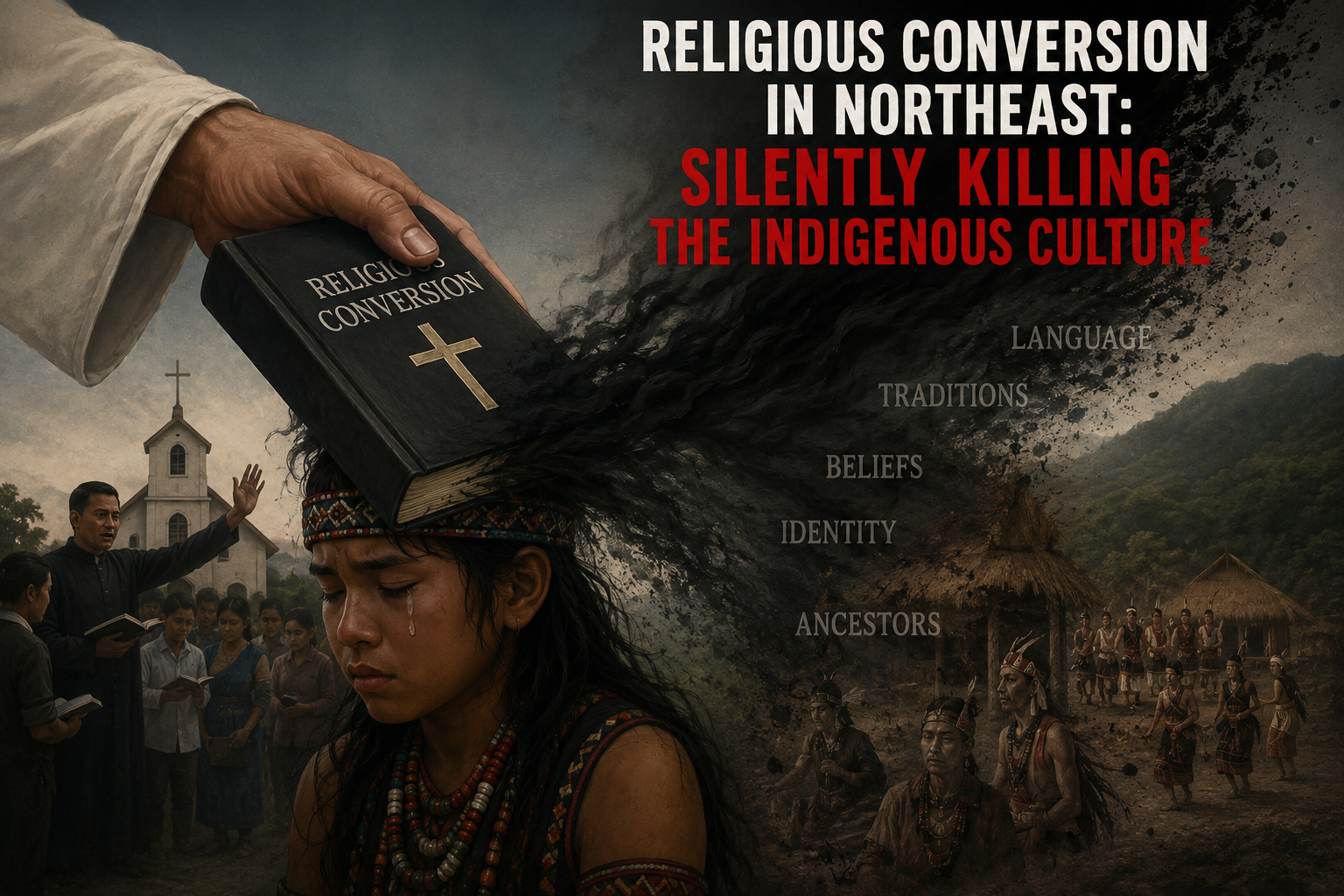
The north-eastern region of India is not merely a geographical territory; rather, it is a vital part of India’s cultural soul. Its tribes, languages, folk traditions, nature worship, festivals, and social life have enriched India’s millennia-old civilization. However, in recent decades, rapid religious conversion in this region has triggered deep social and cultural concerns.
According to many social organizations and local residents, due to organized conversion activities, numerous tribal communities are gradually drifting away from their original culture, traditions, and identity. For this reason, some thinkers term it the “Silent Killer of Indigenous Culture.”
In many remote and inaccessible areas of the Northeast, poverty, lack of education, deplorable healthcare conditions, and unemployment have long been major challenges. Allegations have been raised that certain foreign-funded missionary organizations exploit this situation, targeting poor and simple tribal societies.
In many areas, influence is exerted through schools, hostels, hospitals, relief camps, health camps, and social service initiatives. While welfare work is not inherently wrong, it becomes a matter of concern when it is tied to religious pressure, inducements, or psychological manipulation.
Common Allegations Raised at the Local Level:
* Financial assistance and the lure of free education are offered.
* Ailing individuals are influenced under the pretext of “miracle prayers.”
* Local deities and traditions are labeled as “superstitions.”
* Tribal culture is portrayed as backward, thereby distancing the newer generation from their roots.
In several northeastern states, including Assam, significant shifts in religious demographics and social structures have been observed over the past few decades. In some pockets, the influence of traditional tribal festivals, community worship practices, and local cultural identities has noticeably declined.
Particularly in hilly and border areas, the rise of external influence has created situations of social division. Incidents of increasing mutual alienation based on differing religious identities within the same village have also come to light.
According to analysts, when a society becomes disconnected from its language, culture, folk songs, deities, traditional lifestyle, and historical memories, it does not just change its religion—its collective identity also weakens.
The Role of Cultural Awakening Organizations
We routinely observe that the Rashtriya Swayamsevak Sangh (RSS) and many organizations inspired by it have been active for years in welfare and cultural resurgence programs in the Northeast. The perspective of the Sangh is that tribal society is an inseparable part of India’s core cultural fabric, and preserving their traditions is absolutely essential.
Organizations like the Vanvasi Kalyan Ashram, Sewa Bharati, and several others run initiatives in remote areas including:
* Free education and student hostels.
* Health camps.
* Women empowerment and self-reliance training.
* Sanskara Kendras (value education centers).
* Local culture preservation programs.
These organizations maintain that their objective is to make society self-reliant through service and to reconnect people with their cultural roots, rather than enforcing any form of religious conversion.
Constitutional Freedom vs. Illegal Conversion
The Constitution of India grants every citizen the freedom to practice their religion. However, if conversion is carried out through inducement, fear, coercion, foreign funding, or deception, it raises serious social and legal questions.
Consequently, several states have enacted anti-conversion laws. A need for deep deliberation on this matter is being increasingly felt in the Northeast as well.
What Measures Should Be Taken?
* Conduct impartial investigations into illegal and inducement-based conversions.
* Ensure absolute transparency regarding foreign funding.
* Strengthen government systems for education and health in tribal regions.
* Preserve local languages and folk culture.
* Connect the youth with their history and traditions.
* Launch awareness campaigns at the community level.
The Northeast is a living symbol of India’s cultural diversity. If its tribal identity and traditions weaken, it will not just be a regional loss, but a national one.
The issue of conversion is not merely a question of religion; it is deeply intertwined with culture, identity, social balance, and national unity. Therefore, the need of the hour is to understand any form of cultural disruption occurring under the guise of service and to awaken society.
True development is that which progresses by anchoring a society to its roots—not by alienating it from its identity.
The Present Context: “Breaking India Forces”
International Missionary Networks Post a Grave Threat to the Northeast!
According to many nationalist thinkers and security experts, the aggressive conversion activities in the Northeast are not merely religious endeavors; they could be part of a larger international ideological and geopolitical network. Many view these as “Breaking India Forces”—elements that seek to weaken India’s cultural unity, social harmony, and national integrity.
Allegations also exist that certain foreign missionary organizations establish strong footholds in India’s tribal and sensitive regions through massive foreign funding, international NGO networks, biased media narratives, and platforms operated in the name of human rights.
How Does This Ecosystem Function?
This entire network operates across multiple tiers:
* Building networks of schools, churches, and NGOs through foreign funding.
* Establishing local culture as “backward” and the Western lifestyle as “modern.”
* Fostering a secessionist mindset.
* Alienating local populations from their foundational Indian cultural identity.
* Crafting anti-India narratives on social media and international news platforms.
* Exerting international pressure under the pretext of human rights and minority persecution.
In some instances, it has been observed that following conversion, people’s cultural allegiances gradually shift, and they begin to view themselves as distinct from their ancient traditions. This situation can give rise to social tensions and regional secessionism in the future.
The Northeast is a geographically highly sensitive zone, bordering countries like China, Myanmar, Bangladesh, Bhutan, and Nepal. If cultural disruption and secessionist mindsets escalate in this region, the impact will not remain confined to society alone—it could directly jeopardize national security.
History bears witness that whenever a region’s cultural identity is severed from its national identity, external forces find an opportunity to intervene.
The widespread impact of conversion—ranging from social fragmentation, the erosion of traditional tribal systems, the weakening of local languages and culture, growing distance from national identity, to the incitement of secessionist ideologies, rising foreign influence, and strategic threats in border areas—can present severe challenges for the country in the future.
Conclusion
The borders of any nation are not secured by the military personnel alone. A nation’s true security resides within its culture, society, and national consciousness.
If the people of a region become disconnected from their core civilization, traditions, and national sentiment, the politics of fragmented identity gradually gains strength. For this reason, cultural security is considered a vital component of national security.
In the context of Northeast India, this concern becomes even more critical because its tribal cultures are intricately bound to India’s ancient civilization. If these cultures weaken, both India’s cultural diversity and its unity will bear the brunt.
The solution to this challenge is not merely political, but deeply social and cultural:
1. Instilling a sense of pride within tribal society regarding their traditions.
2. Introducing the younger generation to their true history and culture.
3. Maintaining strict surveillance over foreign funding.
4. Investigating hidden agendas operating under the guise of welfare work.
5. Promoting education rooted in national unity alongside the preservation of local languages and traditions.
Only through these collective steps can the cultural soul and national unity of Northeast India be safeguarded.
India’s strength lies in its diversity. Therefore, it is absolutely essential to identify and expose any force attempting to uproot society from its foundations under the banner of service, relief, or modernity.
Buddha Bharat
The writer can be contacted at M- 60007 16640

