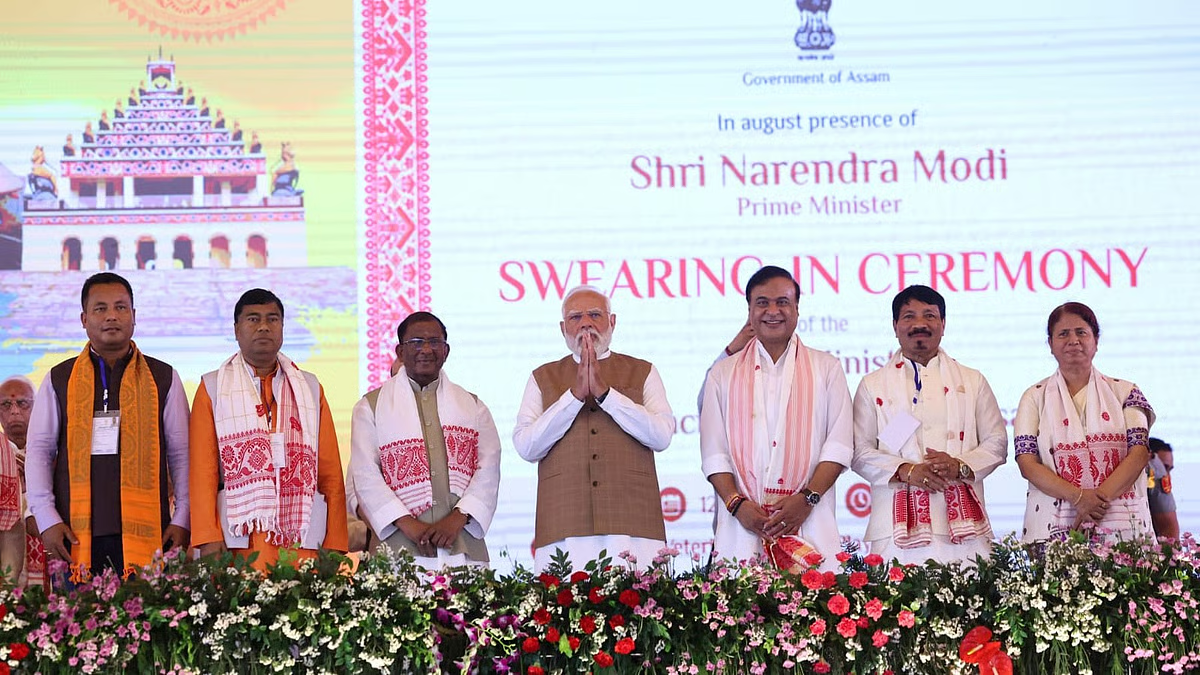
Anything but the saffron waves grip eastern India in recent years and it was truly confirmed by the swiping victory of Bharatiya Janata Party (BJP) in West Bengal and pure consolidation of political power in Assam, where the nationalist party established the consecutive third term electoral victory. When some commentators made optimistic views during the campaigning prior to the recent elections, a few assumed that the BJP-led alliance will retain power in Assam with over a hundred winning seats in its 126-member assembly and amazingly the party alone cross the mark of two hundreds in the 294 Bengal legislators forum defeating the incumbent All India Trinamool Congress.
The counting of votes on 4 May brought a rewarding result for the BJP as it independently succeeded in 82 constituencies where its trusted allies Asom Gana Parishad (AGP) and Bodoland People’s Front (BPF) got 10 seats each. In contrast to the performance of National Democratic Alliance nominees, the opposition Congress along with its electoral partners rested in only 21 seats, where the Gaurav Gogoi-led party was reduced to 19 legislators only.
Political observers believe that the Rashtriya Swayamsevak Sangh inherently contributed for the BJP victory by organizing thousands of Hindu Sanmilans in Assam celebrating the socio-cultural organization’s centenary year ahead of assembly polls. The Sangh had footprints in the alienated region far ahead of the BJP merges as a prominent political party. The Swayamsevaks publicly campaigned for hundred percent voting through personal meetings, public gatherings and social media campaigns. Thus they encouraged and motivated, precisely the Hindu voters to exercise their franchises with no usual hesitations and an overwhelming percentage (85.91) of voting directly helped the saffron nominees in the north-eastern State.
However, a number of foreign media outlets reported the poll outcomes in a negative sense. If the New York Times termed the BJP victory in Bengal as a dangerous expansion of Hindu nationalism, the BBC reported it as a long march of the saffron party into eastern India under the ambitious plan of Prime Minister Narendra Modi, where The Guardian expressed concern over the weakening of oppositions and Al Jazeera went ahead by describing the phenomena as the erosion of Indian democracy. Le Monde opined the rise of BJP in eastern India as a threat to Indian secularism, where CNN depicted the victory as a win for polarisation over progress.
The Washington Post, however, commented that the victory would bolster Modi’s political position ahead of the 2029 national elections. Reuters also acknowledged that the BJP got benefits with the Hindu-centric campaigning. Bangladesh newspapers also admitted that the poll-outcomes would strengthen the ruling saffron party. The Daily Star and Dhaka Tribune apprehended that the voting pattern was influenced by the special intensive revision conducted by the Election Commission of India (ECI) ahead of assembly polls in Bengal, where hundreds of thousands of names (of electorates assuming hardcore supporters of Mamata Banerjee-led TMC) were erased.
Most of the media houses in foreign lands painted Ms Mamata as one of most outspoken critics of Modi and BJP’s religious nationalist agenda, where they apprehended the Bengal victory would only boot the expansionist Hindu-first politics, which came to power to the centre in 2014. The recent series of assembly elections, where voting was also conducted in Tamil Nadu, Keralam and Puducherry union territory, the BJP gained vote shares in those States too. In contrast, the Indian National Congress party lost its visibility except in Tamil Nadu and Keralam. Meanwhile, the Left aligned parties faced humiliating defeats and currently no State the country has a government of their ideologies. It’s now only seven out of India’s 28 States remain under the grip of opposition parties.
Now, millions of BJP supporters keep an eye on urgent actions initiated by both the governments in Kolkata and Guwahati focusing on sustainable development, welfare and security against the illegal entities from neighbouring Bangladesh. When Bengal’s new chief minister Suvendu Adhikari declared an urgent initiative to proceed for handing over required lands to fence the India-Bangladesh border (which was strongly opposed by the TMC government for years), Assam government chief Himanta Biswa Sarma adopted decisions to fulfil the electoral promises including the safeguarding of indigenous population from Bangladeshi Muslim infiltrators. In the first cabinet meeting, Sarma approved the draft bill on Uniform Civil Code for introduction in the upcoming State assembly session.