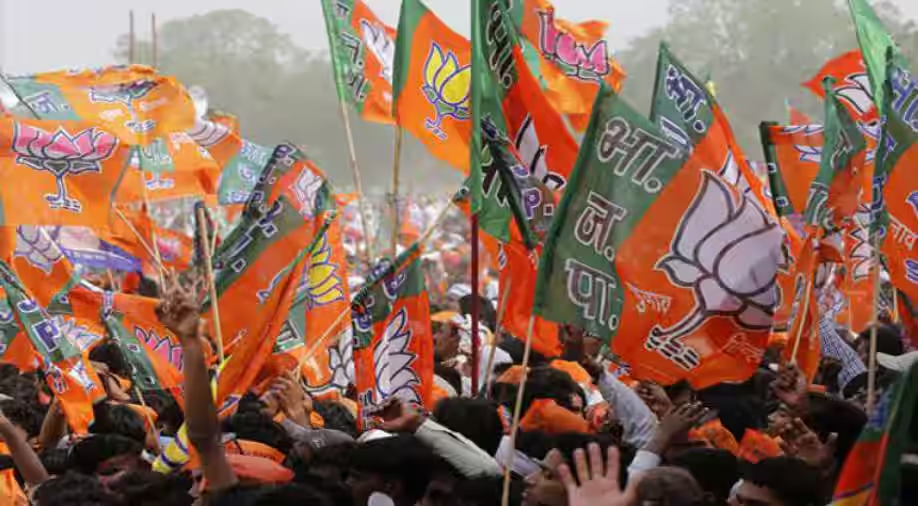
When the Bharatiya Janata Party (BJP) won important legislative assembly elections in two eastern States, both bordering Bangladesh, mixed reactions surfaced from Dhaka. The rise of the nationalist political entity in West Bengal after attaining political power at the centre for more than a decade back was assumed not just an assembly election victory, but a change of electoral equation in eastern India, where Assam was also conquered by the saffron party-led alliance for the third consecutive term. The BJP along with its allies came to power in New Delhi with the 2014 national election and it recorded victory in Assam assembly polls two years later. Soon all seven north-eastern States, except Mizoram, went to the BJP’s political umbrella. But it was a tough electoral battle for the party to conquer Bengal as the eastern State was under the control of Mamata Banerjee-led Trinamool Congress since 2011 assembly polls. For all the years, the hardliner politician Mamata played the role of a strong opposition and even prevented many schemes of the Union government in New Delhi from being implemented in Bengal. From opposing the erection of fencing in the border with Bangladesh along Bengal border, the lady chief minister even restricted many public welfare schemes, initiated by the central government like Ayushman Bharat, Beti Bachao Beti Padhao, Pradhan Mantri Jan Arogya Yojana, Pradhan Mantri Krishak Bima Yojana, Vishwakarma Scheme, Ujjwala Yojana, etc. Finally, the party of rightists succeeded in winning over 200 legislators in the 294-member Bengal assembly and over one hundred seats in 126-member Assam assembly (along with its political allies), where the BJP nominees independently won 82 constituencies. Bengal’s new chief minister Suvendu Adhikari emphasized on urgent initiatives for handing over required lands to fence the India-Bangladesh border, Assam government chief Himanta Biswa Sarma adopted decisions to fulfill the electoral promises including the safeguarding of indigenous population from Bangladeshi Muslim infiltrators.
Meanwhile, the Bangladeshi radical elements apprehended that the domination of BJP in Bengal, Assam and Tripura may increase anti-Muslim narratives. Some of them even publicly warned that if the Muslim residents of the entire region face atrocities because of the BJP’s rise, there would be strong repercussions in Bangladesh (meaning they may go for another series of persecution against Hindu residents and their sacred places of worship). A few of them even hit the streets of Dhaka expressing dissatisfaction over the loss of Mamata’s Trinamool. They alleged that the BJP won the Bengal election with fraudulence and hence Mamata should be reinstated in her post. Bangladesh media reports, quoting local sources, claimed that over 2,500 people were pushed into Bangladesh last year from the border of Assam alone, as Sarma was seen hyperactive in this period. Even during the last election campaign, Sarma made anti-Bangladeshi Muslims comments regularly. He publicly declared that the Muslim infiltrators would be sent to Bangladesh without waiting for mutual diplomatic arrangements.
However, the ruling Bangladesh Nationalist Party welcomed the Bengal election outcome, hoping that the relationship between Bangladesh and India would remain cordial. The Prime Minister Tarique Rahman-led party, which won the February 2026 national election by gaining over 200 seats in the 300 directly elected members in Jatiya Sansad (where Jamaat-e-Islami was a distant second party to win only 68 seats) also congratulated Adhikari for his new responsibility. Many BNP leaders opined that Dhaka can now expect to get the much delayed Teesta water-sharing agreement functional, which was strongly opposed by Mamata during her long tenure as Bengal chief minister. Sheikh Hasina, the ousted Bangladesh premier also congratulated the BJP for its colossal electoral victory in Bengal. The daughter of Bangabandhu Sheikh Mujibur Rahman, now taking an unofficial shelter in India, conveyed her best wishes for the prosperity of Bengal and India in general. Hasina, even facing death sentences in her home country for committing crimes against humanity during the anti-government July-August 2024 uprising now plans to return to Bangladesh once the democracy is restored and political rights get respected in the Muslim majority nation. Probably her return will encourage Bangladeshi progressive writer Taslima Nasrin to return back to her country after decades of living in exile in many countries including India.
Dhaka skeptical over saffron victory