Guwahati: The 4th Pragjyotishpur Literature Festival concluded on 15 November 2026 at Gauhati University (GU) premise in Jalukbari locality after unfolding a world of discussions, deliberations, workshops, book fairs and recitations. The three-day Pragjyotishpur lit-fest (PLF), organised by Sankardev Education and Research Foundation (SERF) under the theme ‘In Search of Roots’, showcased six interactive penal discussions on topics like society, history, literature on nature, cinema and legendary cultural personalities of Assam along with a children drawing competition, recitation workshop and multilingual poetry sessions where the novice writers got the opportunity to present their creative world to the distinguished audience comprising students, scholars, authors, book lovers and literary enthusiasts.
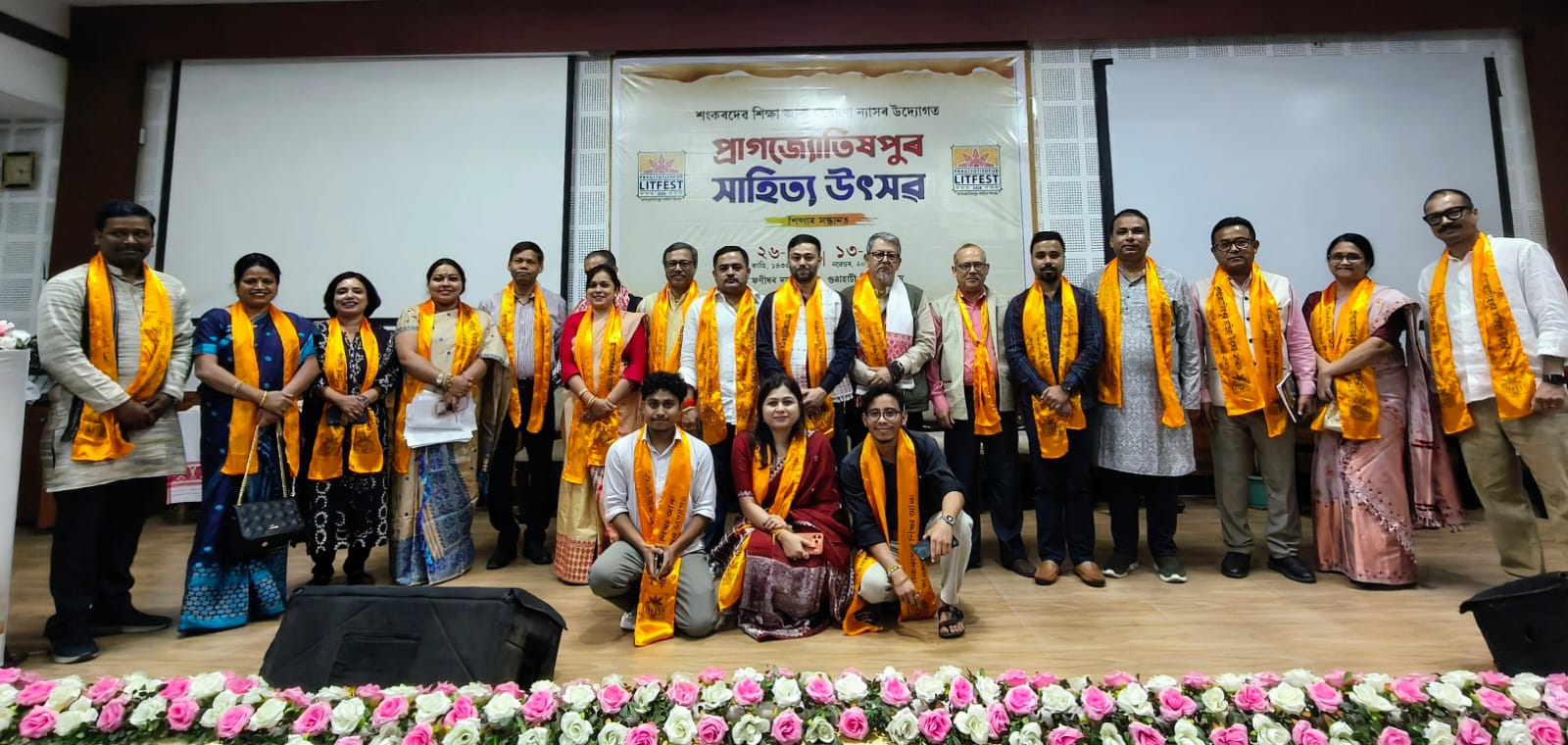
The concluding function at Phanidhar Dutta auditorium of GU also witnessed the presentation of 2026 Pragjyotishpur Sahitya Bota to Karbi Anglong- based author Sir-et Hanse and Pragjyotishpur Literary Award (Youth) to promising writer Ankur Ranjan Phukan. Addressing the gathering, Nagaland higher education and tourism minister Temjen Imna Along lauded the organisers of the prestigious annual lit-fest, focusing on the region’s literary traditions and cultural heritage of ancient Pragjyotish. Temjen, a prominent politician from eastern Bharat, also made a definite appeal to Assamese academia and GU in particular for helping to develop a useful script for Nagamese, spoken by 17 recognized major tribes across Nagaland.
A popular political personality, who remains active on social media, Temjen argued that Nagas used to live under the same umbrella of Assam till a few decades back. Now they expect a resourceful contribution from Assamese intellectual fraternity in finding an indigenous script for their primary lingua franca that is Nagamese, which is mostly derived from Assamese with additional vocabulary and phrases along with phonetic influences from local languages as well as Hindi, Bengali, Nepali and English. Mentionable is that devoid of any indigenous native writing system, Nagamese currently relies primarily on the Latin/Roman alphabet for writing and transcription.
Responding to his aspiration, GU register Dr Utpal Sarma, who was also present on the occasion, assured that the minister’s wish would be carried to the concerned authority with all sincerity. Prominent Assamese playwright Dr Pona Mahanta, senior journalist Kaushik Deka and PLF working president Soumyadeep Dutta also shared the dais. Both Mahanta and Deka emphasized on nurturing mother tongues by using in everyday life and thus preserving a language for the next generation. Young participants of the painting competition and literary workshop were handed over the certificates and medals. Earlier a book titled Amar Prachin Deshar Nam Kamrup, penned by Dutta, was launched in the function.
GU vice-chancellor Professor Noni Gopal Mohant delivered the keynote address in the inaugural session on 13 November, where he elaborated the uniqueness of Assamese sense of identity in the context of Bharatiyatwa from the days of Srimanta Sankardev to present time. Nagaland University chancellor Dr Samudra Gupta Kashyap pointed out some historical events and characters that need rejuvenation. Dibrugarh University’s former vice-chancellor Professor Kandarpa Kumar Deka released the souvenir ‘Pragjyoti’, edited by Hemchandra Doley, where Pragjyotishpur University registrar Dr Devabrat Khanikar was also present. In his address PLF official Dutta welcomed everyone and also recited a patriotic poem ‘Apratirodhya Mor Jatra’, penned by eminent nationalist social worker Basistha Bujarbarua.
Soon after the inaugural ceremony, a panel discussion on the importance of studying Indian history was organised where Dr Kashyap, Professor Ritamani Vaishya, Dr Ankita Dutta and Dr Bhaskarjyoti Sharma participated as panellists. The second session next day on literature and narrative was graced by historian Gajendra Adhiakary, Professor Nandita Saikia, media columnist Devika Dutta and young writer Nabarun Barua. Popular Assamese novelist Manikuntala Bhattacharya, literary critic Dr Pranjal Sarma Basistha, academician Dr Smritirekha Bhuyan and GU Professor Dhurjati Sharma participated in a session dedicated to the literary creations of Mamoni Raisom Goswami (Dr Indira Goswami), an acclaimed Assamese author who won a number of awards including Sahitya Akademi and Jnanpith. A mesmerising interactive session on three luminaries of Assamese music, cinema and theatre namely Jyoti Prasad Agarwala, Bishnu Prasad Rabha and Phani Sarma was presented by Prithiraj Rabha, a popular actor and legislator from Tezpur legislative assembly constituency, while talking to writer Nayanjyoti Bhattacharya.
Recognised as a wildlife conservationist Dutta moderated a session on Indian tradition in preserving nature, where award winning translator Diganta Biswa Sarma, ABILAC director Dr Jogesh Kakati and GU Professor Kuldeep Sharma were present as panellists. Another session on Indian cinema was participated by award winning film-maker Jhulan Krishna Mahanta, GU Professor Bharati Bharali and journalist Nava Thakuria. Well known artiste Ababi Bora conducted the poetry recitation workshop, where two Kabya Kaberi sessions were graced by poets M Kamaluddin Ahmed and Dr Baikuntha Rajangsi. On behalf of the organisers, PLF secretary Bikram Kalita and Dr Hirakjyoti Sarma expressed gratitude to everyone who supported the initiative to promote an intellectual journey in search of roots in Pragjyotish, the pre-historical identity of modern-day Assam.
4th Pragjyotishpur Literary Award to Hanse, Phukan