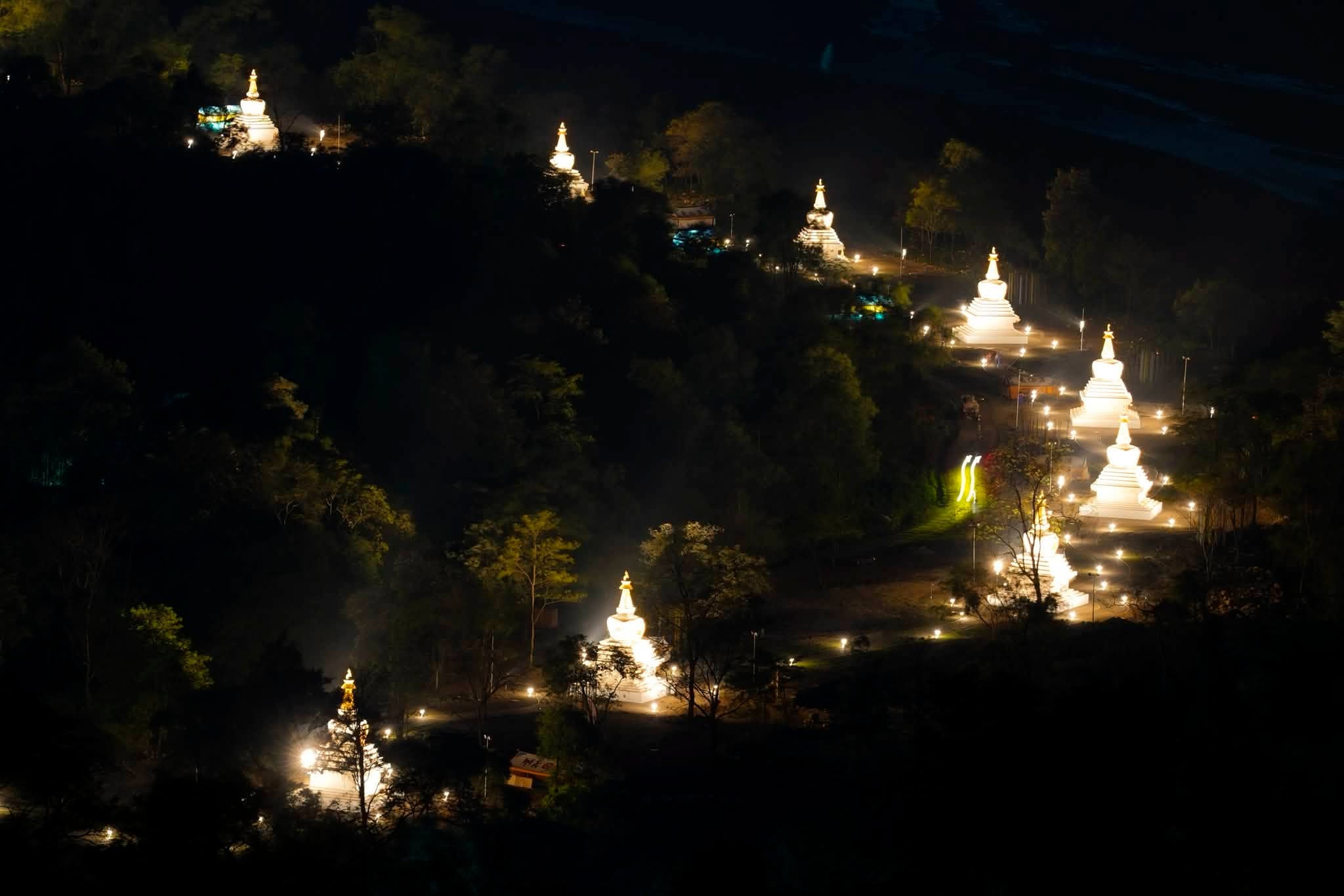
Our tiny neighbour Bhutan offers a goodwill message to India by dedicating a Jangchub Chorten to Prime Minister Narendra Modi on 1 November 2026 emphasizing a close relationship with New Delhi. A sacred ceremony in the Himalayan nation, graced by Bhutan monarch Jigme Khesar Namgyel Wangchuk and Bhutanese Prime Minister Tshering Tobgay, witnessed the gesture from the Royal Government of Bhutan to India for its cooperation in different areas like hydropower, infrastructure, trade, education, and connectivity in general and precisely the upcoming Gelephu Mindfulness City (GMC). Union minister Kiren Rijiju represented India in the ceremony which was attended by hundreds of thousands of Bhutanese volunteers and other people including many from abroad. Chorten, a Tibetan word identifying a traditional architectural form for a sacred Buddhist Stupa, contains religious texts and relics that emerge as a place of prayer, tribute and manifestation. Bhutan, in fact, set a Guinness World Record by simultaneously consecrating 108 such Buddhist monuments of enlightenment in nine hours along Mau Chhu river in Gelephu of the southern part of the country. Each structure is 15 meter tall and positioned 108 meter apart spreading a corridor of over 11 kilometer, where Jangchub Chorten 76 is bestowed to PM Modi. Mentionable is that Bhutan had already conferred its highest civilian award (Order of the Druk Gyalpo) on Modi during his March 2024 visit. The day coincided with the 18th anniversary of King Jigme’s coronation that took place on 1 November 2008. The initiative, pronounced as Project 108 on 21 February was associated with the GMC, Bhutan’s ambitious 2,600 square km environment friendly smart city project, bordering Assam and West Bengal. Enhancing the philosophy of Gross National Happiness, which the Buddhist majority nation practices over material growth (Gross Domestic Product), the GMC portrays new ways of developing a world-class city amidst nature and social harmony. The planned administrative region aims to attract global tourists, talents and also investments keeping the Bhutanese flag flying under a holistic urban development initiative.
Located around 240 km away from the capital city of Thimphu, the world’s first mindfulness city invites investments from various parties opening its doors for sustainable infrastructure development and also mindfulness to every stakeholder. With the current population of around 10,000, expecting to increase up to one million residents by 2065, the city will be empowered with the international standard legal frameworks to govern independently from Thimphu. Accorded with an international airport, scheduled for completion by 2029, with other logistic facilities, GMC aims to strengthen regional connectivity with India. Proposing a carbon-negative region, the city will use 100% renewable energy generated from hydropower plants along with solar, wind and geothermal sources. No less than 30 megawatt renewable hydro & solar energy is projected for generation to feed the city dwellers. Promising at least 60% of its land area under forest covers. The Land of the Thunder Dragon shares a nearly 700 km border with Sikkim, West Bengal, Arunachal Pradesh and Assam. Currently, the initial work for a new rail network connecting Bhutan with Kokrajhar in Assam and Banarhat in West Bengal is going on. The Kokrajhar- Gelephu fully electrified rail link, which has been recognized as the first-ever railway connection between India and Bhutan, spreads up to 69.04 km. The cross-border railway project will connect the administrative headquarter of Bodoland Territorial Region in Assam with Gelephu. Kokrajhar will later connect Bongaigaon with a new 70 km railway track. Thus Gelephu will be connected to all major eastern Indian cities including Guwahati, Siliguri and Kolkata. Another railway line connecting Samtse, an industrial town of Bhutan, with Banarhat of Jalpaiguri locality is also planned with 20 km length. Both the railway projects are expected to offer the landlocked country a faster and cheaper access to the massive Indian markets for boosting tourism and exports. Meanwhile, an upgraded four-lane road is on the card to connect Gelephu with Guwahati. The far eastern part of Bharat now waits for the modern Buddhist oasis, which is poised to be a hub of knowledge, technology, finance, etc.
Hope bilateral trade and commerce would directly benefit the people of western Assam in the coming days.
Message of mindfulness from Bhutan