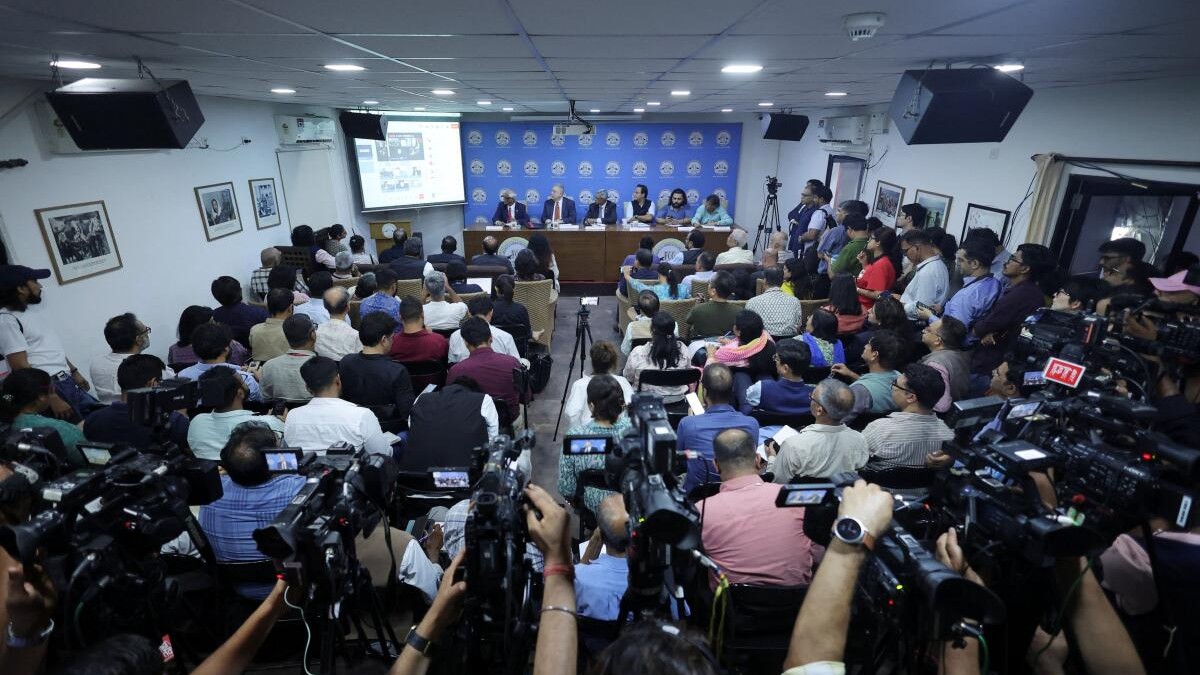
Even though the press conference by ousted Bangladesh premier Sheikh Hasina in New Delhi emerged a much-hyped event, which was live-streamed by many global media outlets, it turned out to be an audio interaction with the Awami League supremo only, where she reiterated about her decision to go back to Bangladesh in December. A number of scribes, attending the program hosted by the Foreign Correspondents’ Club of South Asia on 5 August 2026, tried to get the road map from Hasina about her return journey, but she avoided revealing any particular date or mode of transportations. However, joining the interaction live from Maryland in the United States, Hasina’s son Sajeeb Wazed Joy made some stunning comments on the current status of Bangladesh under the Tarique Rahman-led government, which may generate serious concern for the government and more precisely 60 million residents of the north-eastern region.
Joy claimed in his version that his homeland was turning into another Pakistan, where radical Islamist elements are now operating freely with the support from anti-India foreign elements. Terming Bangladesh as a failed state, Joy apprehended that the country, almost surrounded by eastern and north-eastern territories of India, may become a breeding ground for regional terrorism in the coming days. He also revealed that hundreds of convicted terrorists, arrested and imprisoned by the Awami League government, were recently released. Moreover, various foreign intelligence agencies including Pakistan’s Inter-Services Intelligence, have been running their activities, he stated adding that the next generation of global terrorists would surface from Bangladesh unless the menace is addressed.
Joy did not forget to acknowledge India’s continued support to his mother since Hasina left Dhaka exactly two years back following a student-led massive mass uprising against the Awami League government. In her audio version, Hasina only repeated her determination about returning home. Hasina, 78, who has been living in New Delhi as a self-imposed exile since 5 August 2024, entertained many international news agencies with text interviews. The daughter of Bangabandhu Sheikh Mujibur Rahman asserted that ‘whatever the fate awaits’ her, she would return back. Remembering enormous struggles by her father during the 1971 liberation war and sacrifices by uncounted Muktijoddhas, Hasina in a shocked voice stated, no fear of her life could decide her return to Bangladesh, because her country-people are suffering with no ‘security, development, prosperity and peace’. She opted to go back in December as it’s the month of victory (from Pakistani forces on 16 December 1971).
In her first public address in two years, Hasina mentioned about the 2024 July-August rebellion and alleged that some motivated elements penetrated into the job quota reform movement with the single-point agenda to seek her resignation. Initially surfaced peaceful protests soon turned violent, where the demonstrators started engaging in widespread killings-arson- attacks on public infrastructure and law enforcement agencies. Hasina exclaimed that the systematically orchestrated protest compelled her to leave Bangladesh, but that could not separate her from the people of her beloved country. She also claimed that the 12 February 2026 national election was stage-managed as her party Awami League was not allowed to participate and hence the suffering of Bangladeshi nationals continued. The countrymen remain under the grip of fear, repression and economic hardships, she asserted.
The last general election was felicitated by Professor Muhammad Yunus-led interim government, which took charge following Hasina’s escape from Ganabhaban (Prime Minister’s Office), after 18 months, where Khaleda Zia’s Bangladesh Nationalist Party (BNP) emerged victorious. BNP chief Tarique Rahman became the new premier of the south Asian nation. Meanwhile, Hasina was awarded a number of punishments including a death sentence in absentia by the International Crimes Tribunal (of Bangladesh) for her crimes against humanity during the highly exposed July-August uprising. Even her party was restricted from carrying out political activities and also contesting elections in the country.
The latest development has definitely complicated the bilateral ties between India and Bangladesh, if not deteriorated to a larger extent. As Bangladesh is almost surrounded by India’s eastern region (West Bengal with 2,217 kilometer, Assam with 262 km, Meghalaya 443 km, Tripura 856 km and Mizoram 318 km), the emergence of radial forces there may create serious security concerns for India. Once banned Bangladesh Jamaat-eIslami has lately entered their Jatiya Sansad (national assembly) with the second highest number of elected lawmakers after the BNP. The anti-India rhetoric of various Bangladeshi outfits needs to be addressed diplomatically and it would require New Delhi’s cordial relation with the authorities in Dhaka. Only time will tell, when the moments of mutual understanding between India and Bangladesh will surface and it will continue for good.
If Bangladesh becomes another Pakistan !