Subhasish Chakraborty
Manipur, the birthplace of modern polo, holds a rich cultural and
historical legacy that stretches back thousands of years. From its
royal origins to its global prominence today, the sport has evolved
into a symbol of prestige, with Manipur at its heart
Having been born and brought up in India’s North Eastern state
of Assam, from my childhood I heard stories from my uncle and
aunts on the game of Polo and how it originated in India’s
remote North Eastern state of Manipur. I never gave much
importance to them. But today, in hindsight, the manner in
which Polo has evolved as a sport of the rich and the famous, I
feel fortunate enough to belong to that region from where Polo
originated and to be able to offer a glimpse of this exciting
game to the discerning global Polo aficionados.
Far removed from mainland India, Manipur is located in North
East India and is bordered by Nagaland to the North, Assam to
the west and Mizoram to the South West. On the South and East,
Manipur is surrounded by Myanmar. The capital of Manipur is
Imphal, a city with a rich, virile past and a vibrant cultural
melting pot. Manipuris is often referred to as “The Jewel of
India” because of being encircled by nine hills with an
oval-shaped valley right at the centre.
The Guinness Book of Records in its 1991 edition on page 288
writes, “Polo: Origins: Origins of Polo can be traced to
origins in Manipur State c. 3100 BC. when it was played as
Sagol Kangjei”. In fact, the Manipuri Pony is one of five rare
equine breeds in India, and equestrian experts are of the
opinion that the Manipuri Pony is a descendant of the renowned
Mongolian Pony – a combat horse that is steeped in legends,
mythologies and folklore.
Legend has it that King Kangba invented the game way back in
the 14th century BC, and in 33 AD, the first-ever polo match
was organized by King Nongda Pakhangba. In popular Manipuri
folklore, there is mention of this unique game and the fact
that even celestial gods of the Hindu pantheon were delighted
by the foundation of this game, which they regarded as the
victory to the erstwhile Meitei kingdom of Manipur. Today, as
it was the precedence centuries back, the people of Manipur
have the belief that the Manipuri Polo rules were crafted by
none other than “Marjing – The God of Polo”.
In the 1850s, when India was ruled by the British East India
Company, British soldiers and tea planters, on their way to
Silchar came across a motley crew of Manipuri princes’ who
indulged themselves in a game that looked like playing hockey
on horseback. They were stupefied by the sight of men wearing
turbans and clad in traditional “pheijom”,shin-guards and
brandishing mallets engrossed in an exciting sport.
In modern times, the British, who are so enamoured by this
great game, first took the lead role and brought the game out
in the open, albeit a Polo Game, in the year 1853 under the
watchful guidance of Capt. Robert Stewart, who then was an
integral part of the British Cavalry. This is recorded in the
annals of Polo as the first official game – British East India
Cavalry Vs Manipuris! And the spirit of enterprise shown by the
Britishers meant that in a span of just six years, in the year
1859, Col. Joseph Sherer set up the world’s first polo club –
The Silchar Kangjei Club.
And the rest, as they say, is history – the game of polo began
to spread its tentacles in the rest of India. Needless to say,
UK was the first nation in the Western world where the first
game of Polo was played, courtesy of Edward “Chicken” Hartopp
at London’s renowned Hounslow Heath in 1869.
Polo historians are of the opinion that it was after 1869 that
connoisseurs of the game came together to formulate the rules
under the stewardship of London’s Hurlingham Club that would go
on to govern this great game.
Today, thanks to the pioneering spirit of sportsmanship shown
by many nations, the game that originated in one little speck
of paradise in India’s remote North East – Manipur, is today
played in more than 70 countries! What is more, in spite of
being one of the hardest equestrian sports, Polo has evolved so
beautifully over the past century and more that today, this
game, which grew from its humble origins in the Indian state of
Manipur, is today associated with the rich and the famous.
According to Bill Askins, an experienced Polo player with years
of experience under his belt – “It certainly helps your polo
career if you have a lot of money to spend on the sport! To
play top polo takes courage, athletic ability, real riding
skills and a lot of time to devote to the sport! Very few
people have these prerequisites so it limits the number of
participants in this magnificent sport. In the USA there are
now about 3,000 people that play on a regular basis”.
The modern-day Polo game ambience is best summed up by Polo
enthusiast Jeannine Clark thus – “Finely-dressed men drink
vintage champagne from tall flutes, while women in designer
hats nibble on fresh fruit and croissant sandwiches from tables
covered with white linens. As they sit and sip, they while away
the afternoon watching one of the oldest and fastest team
sports in world history.
A scene from a Merchant Ivory film, perhaps? No – it’s just
another summer Sunday at the San Diego Polo Club in Rancho
Santa Fe, California” .
That’s the kind of excitement that prevails in high-profile
Polo matches. On the one side, you have the glitz and glamour
of the audiences under the tent; on the other hand, you have
players dressed in colourful attires pummelling the field on
horseback.
Today, as a much-published travel writer born in India’s
Marlboro Land – The North East, I am proud to see great strides
being undertaken, particularly by women folks in the birthplace
of Polo!
Huntre!Equine – a social welfare organisation credited with
linking women Manipuri Polo players with the Western world, the
US to be precise, is the stuff of legends. Polo linkages aren’t
all that easy, even more so when it involves a Third World
country. The cost part is especially tough, and not many are
eager to sponsor. But, beating all odds, Hunter! Equine has
managed a miracle – organising Polo matches by inviting
American Polo players to participate in games involving
Manipuri women Polo players. Needless to say – It’s a marriage
made in heaven!
As the astonishing success of Manipur’s Huntre! Equine’s
landmark effort spread worldwide to the discerning Polo
audience; the unsung stories of Manipur’s women polo players
have now metamorphosed in the form of a movie – “Daughters of
the Polo God.” This 33-minute inspiring documentary by Roopa
Barua won the highest honour at the New York Equus Film
Festival – the Festival Director’s Award as well as the Best
Documentary Short Award at the prestigious Film Festival in
2018. If all goes well, the film is listed to be screened
across the US this year.
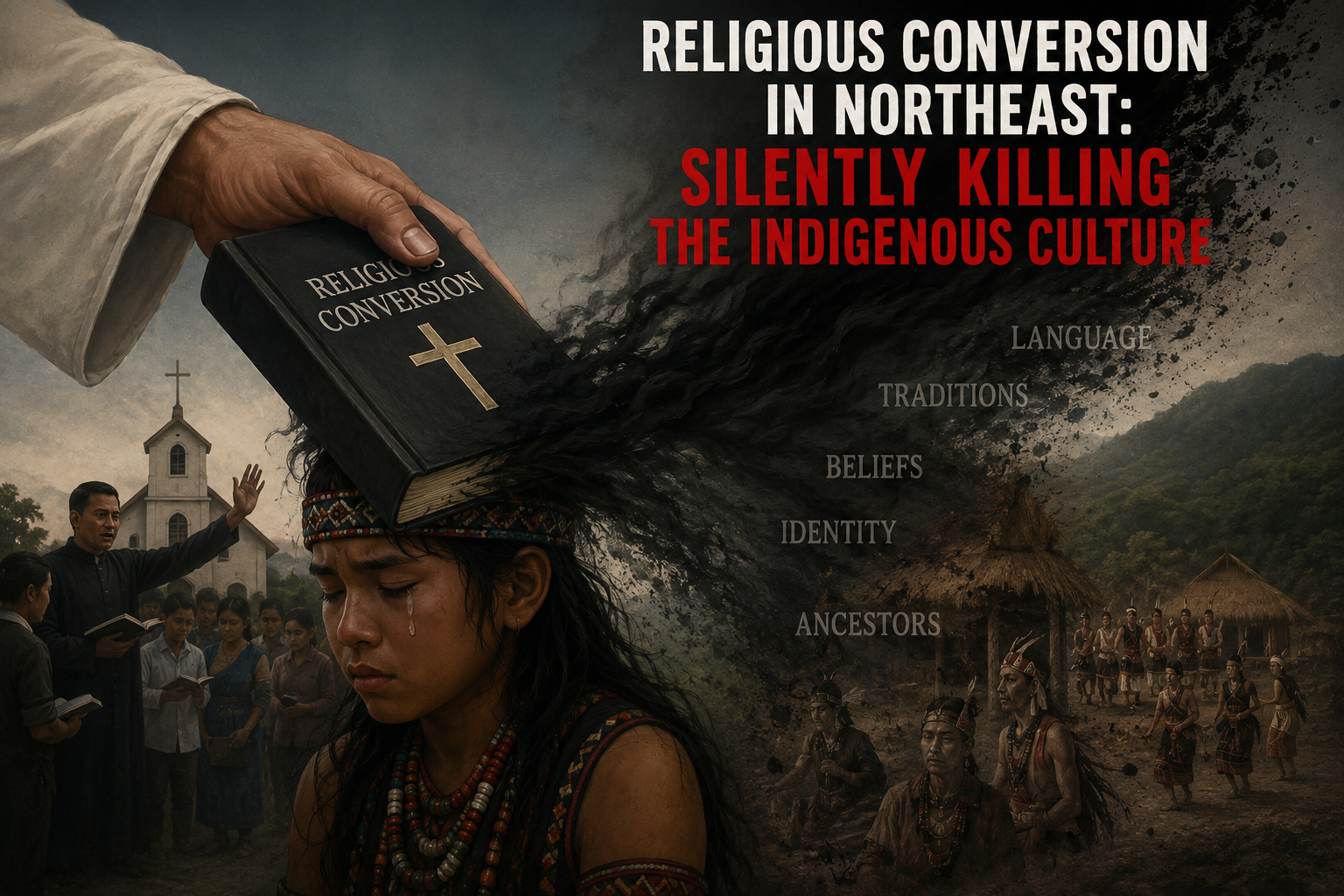
Manipur isn’t just about Ponies & Polo. In fact, its a
multi-ethnic state and the hills are inhabited by fascinating
tribals – the Nagas, Kukis, Rongmei (Kabui), Simte, Suhte,
Tangkhul, Tarao, Thadou, Thangal, Vaiphei, Zeme …….A veritable
Anthropological hotspot, to say the least!
Consider, for instance, the Ao Nagas. After marriage, the bride
and the groom leave their family of orientation and establish a
new family. The Ao Nagas do not practice polygamy. As a family
unit, they live in complete harmony. If a younger member of the
family quarrels with a senior person of the family, it is
believed to be ominous not only to the family but also to the
village as such.
Ao Nagas also have clans that are patriarchal and exogamous.
The ‘Morung’ or Bachelor’s Dormitory plays a vital role in the
social life of the Ao Naga village. Most ‘Morungs’are fine work
of craftsmanship. It serves both as a guardhouse as well as a
clubhouse. The women are forbidden to enter inside a ‘Morung’.
The young boys are admitted into the ‘Morung’ every three years
to get trained practically in order to become perfect men in
all spheres.
Visitors intending to visit Manipur would do well to coincide
their trip during the annual Naga Hornbill Festival
http://hornbillfestival.com/ , a weeklong celebration
showcasing the best of Naga tribal culture and heritage. The
festival is held in December at the charming village of Kisama
in the neighbouring state of Nagaland. The theme of the
festival is very apt – “Window to Nagaland”. Apart from the
Hornbill Festival, Manipur has numerous other ethnic festivals
that are held with great pomp and grandeur. Check out with the
Tourism Department for exact dates.
There is a sense of mysticism associated with Manipur, which
has been further heightened by its remoteness and geographical
isolation. One can not only savour the ancient animist
practices, but if, for instance, one were to embark on a jungle
expedition, the lure of bonding with some of the most
fascinating tribes on planet Earth would invigorate even the
most jaded of travellers.
As Manipur emerges as a centre of Polo in India, here is
wishing the discerning global traveller a journey of stupendous
dimensions. Are you up for the RIDE?