 Solar power plants to address global warming: Governor Mukhi
Guwahati: The global warming, one of the manifestations of climate change, is causing air and sea temperatures to rise and also leading to more evaporation. Warmer air can hold more moisture, which would make monsoon rainfall more intense. The recent flood ravaged picture of Haflong and Silchar indicate that Assam also starts receiving the brunt of climate change, commented Governor Jagdish Mukhi.
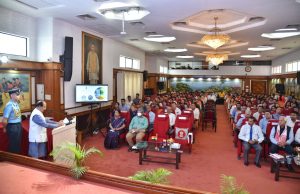
Speaking at a seminar on climate change organized in Raj Bhavan Assam recently, Governor Mukhi also added that climate change is one of the greatest threats to global security which knows no borders and presents an existential challenge to environment and humankind. Climate change can cause droughts which can be more frequent and severe. It is making the weather system more unpredictable and severe, asserted the Governor.
Mentioning about the recent floods in Pakistan and unusual rainfall in southern India, Governor Mukhi commented that the intense monsoon rains in the last few months was the impact of climate change, part of which is man- made. Since human beings use a lot of fossil fuels (petrol or coal), they release a lot of carbon-dioxide which is primarily a greenhouse gas. The increase of greenhouse gases in the atmosphere leads to the cause of global warming, analyzed the Governor.
As the Earth warms, the glaciers in the poles start melting and thus raising the sea level. The rise in water threatens to change the topography of many countries. Some coastal cities are expected to be underwater in the next century, he added. Speaking about India as a supporter of science-based understanding of climate change since the very beginning and rational approaches to resolve it, Governor Mukhi stated that the great country has been supporting and contributing to the intergovernmental panel on climate change.
“Recently, India for the first time came out with its own climate change assessment. Its approach to combat climate change has been through adaptation and mitigation. Policies like National Solar Mission are aimed to reduce dependence on coal powered plants and thus reduce carbon footprint. India is one of the few countries on track with the Paris agreement to reduce carbon footprint by 33-35% by 2030,” said the Governor.
He disclosed that under the leadership of Prime Minister Narendra Modi, New Delhi is advocating a policy called Panchamrit that is five key commitments to deal with the challenges of climate change. Right from reducing the country’s carbon emissions to increasing India’s reliance on renewable energy, New Delhi has been working to deal with the threats precipitating from climate change. The Governor also added that Assam government’s policy on solar power is its testimony of seriousness to beat climate change.
The seminar was graced by well-known resource persons like Assam’s top bureaucrat Ravi Shankar Prasad, former IIT Guwahati professor Arup Kumar Sarma, TERI fellow RR Rashmi and IITG professor Dr Anamika Barua, who extensively deliberated on the ways & means and also a broad strategy to empower Assam to contribute to India’s efforts to deal with climate change. It was attended by higher officials of Raj Bhavan and various government departments, research scholars, students from a number of universities and media persons.