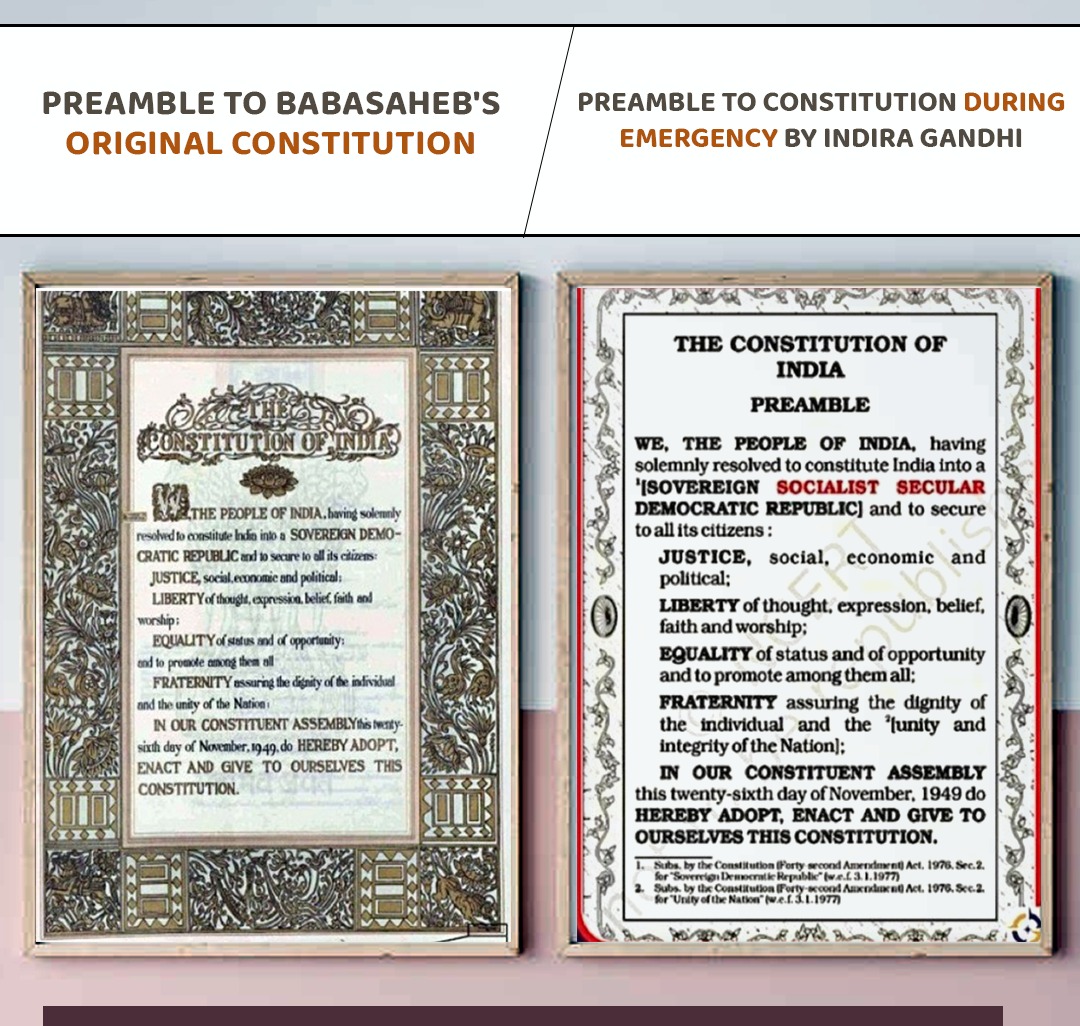
When the Indian Constitution was being framed between 1946 and 1949, the framers were acutely aware that they were laying the foundations of a sovereign, democratic republic born out of a long and painful freedom struggle. At that moment in history, India was a newly independent country, emerging from the trauma of Partition and trying to forge national unity amidst immense linguistic, religious, and cultural diversity. The members of the Constituent Assembly, representing a wide ideological spectrum, from socialists and liberals to Gandhians and conservatives, engaged in deep and nuanced debates about what kind of state India should be. Among the points of contention was whether the Preamble should contain words like “socialist” and “secular.”
Despite their ideological sympathies with socialism, the Constitution-makers ultimately chose not to include the word “socialist” in the Preamble. Dr. B.R. Ambedkar, the chief architect of the Constitution, argued that the Constitution should not commit the country to any particular economic system. While many leaders of the freedom movement, including Jawaharlal Nehru, believed in a socialist pattern of development, they were conscious that India’s democracy should allow future generations to decide their own economic path. Ambedkar made it clear in the Assembly that what kind of economic structure the country should adopt must be left to the will of the people through democratic processes. Embedding “socialism” into the Constitution, he warned, would tie future governments to one rigid economic model and curtail the flexibility needed to adapt to changing times and circumstances. Therefore, even though the Directive Principles of State Policy reflected socialist ideals like welfare of the people, equitable distribution of resources, and workers’ rights, the Constitution-makers consciously left the term “socialist” out of the Preamble.
Similarly, the word “secular” was not included in the original Preamble. This was not because the framers did not believe in secularism, on the contrary, many of them were deeply committed to the idea of a secular state. However, they believed that the values associated with secularism such as religious freedom, equality before the law, non-discrimination on religious grounds, and the neutrality of the state in matters of faith, were already firmly embedded in the body of the Constitution. Articles 25 to 28 provided for freedom of religion and conscience. Articles 14 and 15 enshrined equality before law and prohibited discrimination on the basis of religion, among other grounds. Nehru and others were concerned that an explicit mention of the word “secular” in a post-Partition India, still reeling from communal tensions, might be misinterpreted as hostility towards religion. They wanted the Constitution to respect all faiths, rather than be seen as anti-religious.
Throughout the Constituent Assembly debates, socialist member K.T. Shah repeatedly moved amendments to insert both “socialist” and “secular” into the Preamble. But these were consistently rejected. The dominant view in the Assembly, including by Ambedkar and Nehru, was that it was unnecessary and perhaps even unwise to insert such terms in a constitutional document that was meant to endure through changing political and economic circumstances. They preferred to focus on principles and values in action, rather than include ideological labels in the Constitution’s opening declaration.
Ironically, the words “socialist” and “secular” were later inserted into the Preamble not at the founding of the Republic, but during a period of internal political crisis. In 1976, during the Emergency imposed by Prime Minister Indira Gandhi, the 42nd Amendment Act was passed, adding the terms “Socialist” and “Secular” to the Preamble. This move has been widely debated. Critics have argued that it was a politically motivated attempt to consolidate power and signal progressive credentials during a time of intense authoritarianism. Supporters, however, contend that these additions merely formalized what was already the spirit of the Constitution. Nonetheless, it remains true that these words were not part of the original vision of the framers.
The absence of the terms “socialist” and “secular” in the original Preamble was not an oversight. It was a conscious and thoughtful decision rooted in democratic foresight. The Constitution-makers believed that the role of the Constitution was to create a flexible, inclusive, and enduring framework that would empower future generations to shape India’s economic and social character through democratic means, rather than bind them to any fixed ideological model. Their restraint reflected a deep commitment to democratic freedom, institutional stability, and the evolving nature of Indian society.