As U Min Aung Hlaing, a top military commander turned President of Myanmar (formerly known as Burma or Brahmadesh) completes his five-day official visit to India, political observers start analyzing its aftermath, where the Myanmar bordering India’s far eastern region expects benefits in several fronts from security to communication to developments. Elevated to the civilian post following a debatable national election during December 2025 and January 2026 in the southeast Asian nation, Hlaing made his first overseas trip to the largest democracy on Earth. When the poverty stricken country of 55 million Buddhist majority people has been facing a civil war with the quasi-democratic government currently rules less than half of its territory, the visit was an urgent necessity for Hlaing, when New Delhi has taken it as an opportunity to enhance bilateral ties with the eastern neighbour.
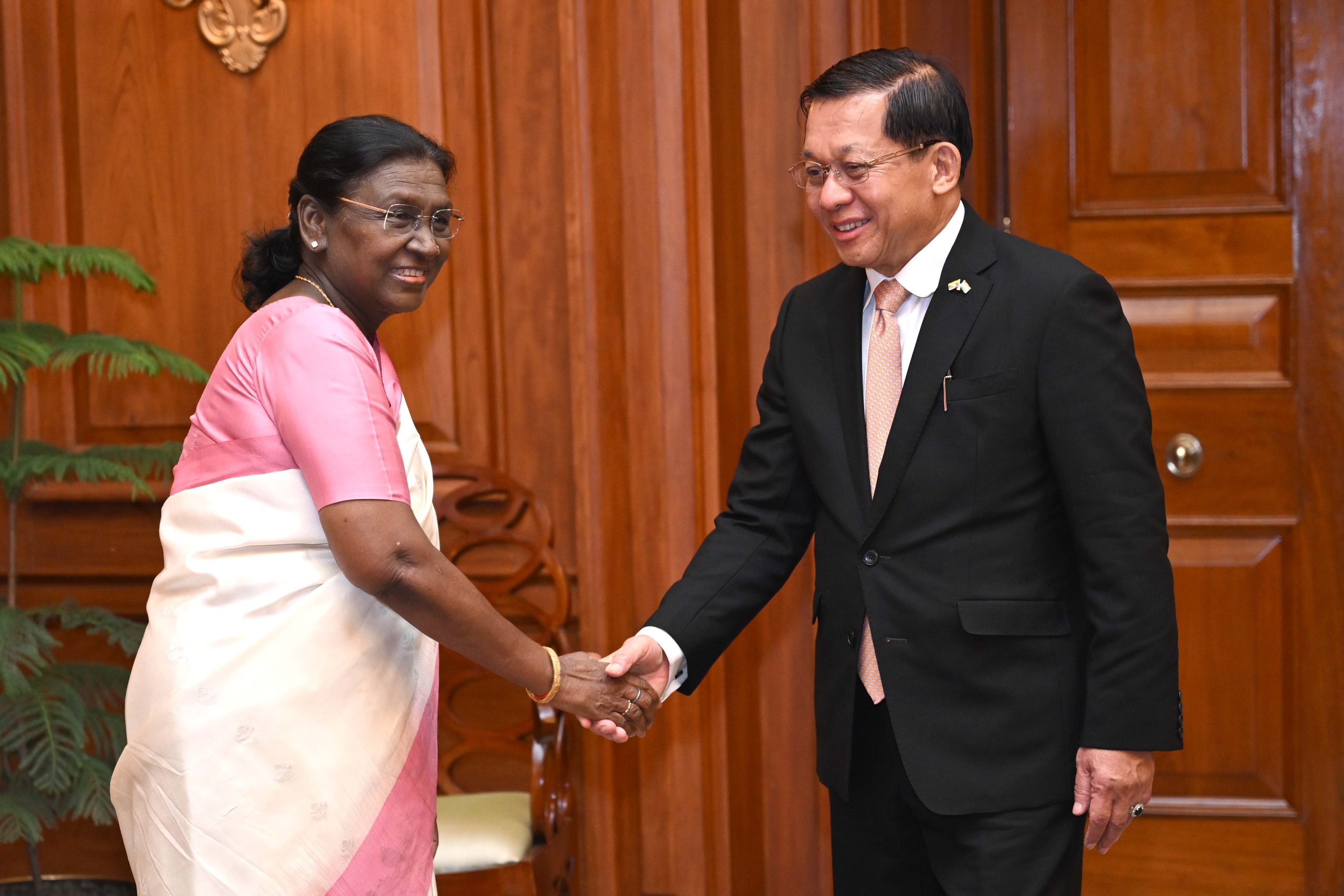
Hlaing, who landed at the Buddhist pilgrimage site of Bodh Gaya in Bihar on 30 May with a delegation of ministers, government officials and business representatives, had an important meeting with Prime Minister Narendra Modi on 1 June in New Delhi. Both the leaders exchanged their views on fostering multifaceted cooperation in the economic, religious, cultural, and social sectors with an aim to strengthen the old ties between the governments and peoples of the two countries. Hlaing also met a number of high profile dignitaries including President Droupadi Murmu at Rashtrapati Bhawan. Before departing on 3 June from Mumbai, Hlaing discussed with India’s external affairs minister S. Jaishankar on various pertinent issues and also graced trade & investment forums in both the political and commercial capitals of India.
Even though Modi and Hlaing did not address the media after their meeting, foreign ministry spokespersons stated that they discussed trade, border management, defence cooperation and various regional issues. They also emphasized on preventing any misuse of respective territories for harmful activities to the neighbours, where Hlaing assured that Myanmar would not allow its territory to be used by separatist insurgents against India’s security interests. Modi also raised his concern over the implications of Myanmar armed groups’ presence in border areas spreading over over 1,600 kilometre and subsequent military crackdown against those militias. The conflict situation has compelled many to flee and enter the Indian territories thus impacting the residents in bordering localities, Modi is understood as conveyed to Hlaing.
The stalled Kaladan multi-modal transit transport project that aims to connect Sittwe port in Rakhine/Arakan State to the landlocked north-east Indian region was also discussed during the meeting. The Kaladan riverine project, which was supposed to be made operational ten years back, continues facing difficulties in the completion of constructions primarily due to political turmoil inside Myanmar. Another project named India-Myanmar-Thailand Trilateral Highway, aiming to connect India with the southeast Asian nations, also gets delayed for years due to the unstable situation in Myanmar, which raises security concerns for all stakeholders. Needless to mention that both the Kaladan and trilateral highway projects are known as primary focus areas under New Delhi’s ‘Neighbourhood First’, ‘Act East’ and ‘MAHASAGAR’ policies.
Modi also pushed for sustainable peace and democracy in Myanmar while raising the issue of jailed pro-democracy icon Daw Aung San Suu Kyi, who remains behind bars since the 1 February 2021 military coup, which was incidentally orchestrated by Hlaing himself. As the commander-in-chief of Burmese army, Hlaing dethroned a democratically elected government of National League for Democracy (NLD) led by Suu Kyi. Currently serving long years of sentence under house arrest somewhere in Naypyitaw, the Nobel peace laureate is speculated to suffer from various physical ailments. Meanwhile, the country slips into a pure chaos as a number of ethnic armed groups and people defence forces launched a coordinated offensive in October 2023, resulting in a large number of townships and rural areas going under the control of those anti-junta fighters.
Following a Burmese President’s visit