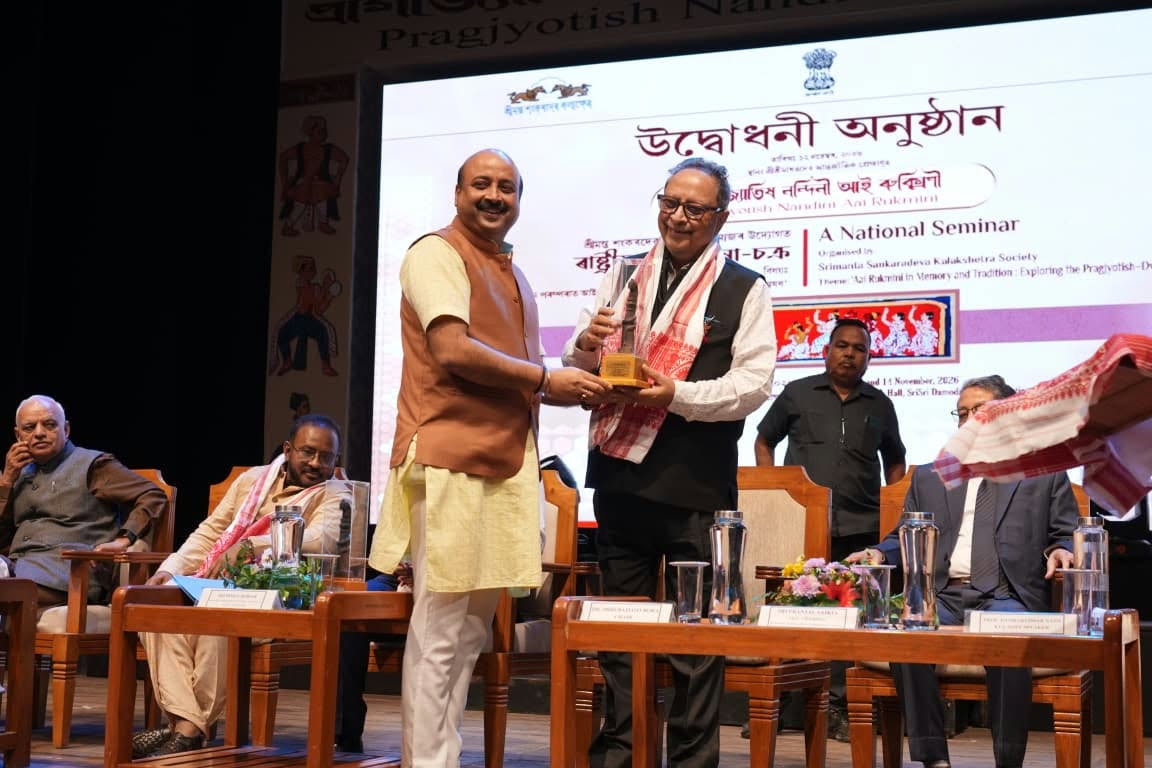
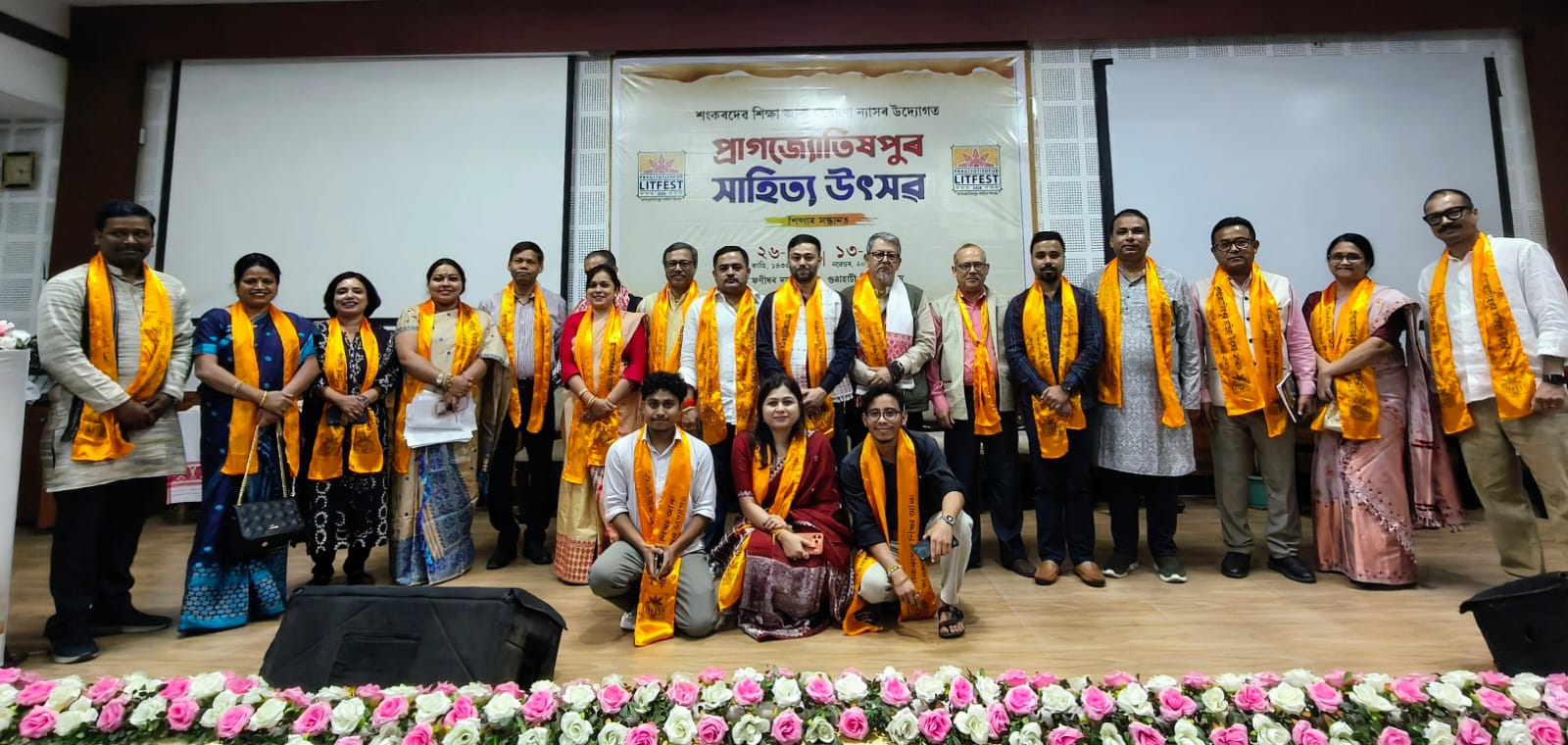
A national seminar titled ‘Aai Rukmini in Memory and Tradition: Exploring the Pragjyotish–Dwarka Connection’ at Kalakshetra premise of Guwahati on 12, 13 and 14 November 2026, brought a refreshing reminiscence of Rukmini, the chief consort of Lord Krishna, to the public discourse. The three-day colloquium, organized by Srimanta Sankaradeva Kalakshetra Society (SSKS) at Madhavdev auditorium in Panjabari locality, brought together a number of prominent scholars and researchers from Assam, Arunachal Pradesh and Gujarat. It may be mentioned that numerous stories relating to Vishnu descended as Krishna and Rukmini, an incarnation of Goddess Lakshmi, occupy a distinctive place in the religious imagination, literary traditions and cultural memory of the people across Bharat.
The golden city of Dwarka represents the western sacred landscape, from where Krishna voyaged to pick up his first queen, Rukmini, who chose her own husband and resisted an arranged marriage with Shishupal, the crown prince of Chedi kingdom, by her father Bhishmak Nripati. Finally Krishna saved her from an unwanted marriage and made her the queen of Dwarka. Rukmini, the blessed daughter of Pragajyotish, finds enormous space in Gujarati folk culture for centuries. Many Gujarati traditional wedding songs cite Rukmini with high honour and even the connection of Dwarka with Pragajyotish including Rukmini’s covert message to Krishna. A glimpse of the journey undertaken by Krishna with his horses-pulled chariot to bring Rukmini to Dwarka gets mention in those oral literature, where Krishna travelled along a route touching Vindhyachal and covering rivers like Ganges, Jamuna along with a sealike Brahmaputra. In her secret letter to Krishna, Pragjyotish-Nandini highlighted her location as where the sun rises and sets earlier than other parts of the country.
Sahitya Academy award winning Gujarati author and researcher Raam Mori, while presenting his paper in the seminar, claimed that those folk ingredients give a clear idea about the geography of Rukmini’s land. Gujarat Sahitya Akademi secretary Prof Jayendrasingh Jadav also echoed the theory that Rukmini belonged to Pragajyotish in present-day eastern India. Prof Ajaysingh Chauhan from Gujarat Central University, in his address, asserted that the tradition of Ras festival in Gujarat was inspired from Assam following the initiative of Devi Rukmini. He also highlighted the story of Usha and Anirudha citing Gujarati litterateur Premanand’s poem ‘Usha Haran’, where ancient relationship between Dwarka and Pragjyotish is reflected.
The 15-16th century Vaishnavite saint-scholar, playwright and socio-religious reformer Srimanta Sankaradeva created a devotional one-act play and narrative poem named ‘Rukmini Haran’ adapting the marriage of Krishna and Rukmini from the primeval Sanskrit Hindu literary texts like Bhagavata Purana (also known as Srimad Bhagavatam) and Harivamsa (also known as Harivamsa Purana). The cult figure in the Bhakti (devotion toward Krishna) movement in eastern Bharat localized the creations relating to the Bhishmaka Nripati’s daughter to present-day Assam and Arunachal Pradesh. One of Sankaradeva’s disciples Ananta Kandali authored a narrative poem titled ‘Kumar Haran’, where the sixteenth-century poet of Kamrup interpreted the story of Usha and Anirudha’s union and divine marriage.
A musical play titled ‘Krishnamoy Pragjyotish’ was staged on the occasion, which was enjoyed by a distinguished audience comprising Assam Governor Lakshman Prasad Acharya, State chief secretary Ravi Kota, Gujarat Sahitya Akademi chairman Dr Bhagyesh Jha, SSKS vice-president Pranjal Saikia, etc. Penned by Satriya dances exponent Padma Bhushan awardee Jatin Goswami and directed by Seujpriya Barthakur, the play presented Shri Krishna’s visits to Pragjyotish in three episodes while arriving in the ancient land to wed Rukmini, eradicating Narkasur, the mythical ruler of Pragjyotish-Kamrup (present-day Assam) with the help of his queen Satyabhama, and helping Anirudha to marry the daughter of Ban Nripati.
Assam’s cultural minister Bimal Borah, while gracing the inaugural ceremony, opined that the epic relationship between Pragajotish and Dwarka covering historical geography, folklore and literary resources should be analyzed scientifically. He believes that this seminar opens the opportunity for further discussions on the age-old connection between the far eastern and western parts of Bharat. In the presence of Dr Dhrubajyoti Bora, Diganta Biswa Sarma, B Kalyan Chakravarthy, Sunil Kr Dutta and other dignitaries, Borah hoped that an in-depth research covering Malini Than, Aswaklanta etc, associated with the legend of Pragjyotish-Nandini Rukmini, should continue taking valuable elements from the archaeology, legends and temple literatures.
The intriguing seminar was also contributed by Prof Ananda Bormudoi, Prof Dambarudhar Nath, Prof Mrinal Medhi, Dr Hemendra Nath Dutta, Dr Pallabi Bora, Dr Bhupen Chutia, Prof Akunthita Borthakur, Prof Noni Gopal Mahanta, Prof Amalendu Chakraborty, Prof Sudeshna Bhattacharya, Prof Satyakam Borthakur, Prof Chandan Sarma, Prof Binita Bora Dev Choudhury, Dr Manjil Hazarika, Dr Prashanta Kr Chutia, Dr Samudra Gupta Kashyap, Dr Jogesh Kakati, Dr Razzeko Delley, Swapnanil Baruah, Jayanta Madhab Bora, Pratap Kr Neog, Manjula Baruah, Simran Sambhi, Tirthankar Das Kalita, etc.
SSKS secretary Sudarshan Thakur opined that the seminar was aimed to seek an intellectual study highlighting the bond between two Rukmini-Krishna traditions bringing together textual traditions, historical references, archaeology, sacred geography, oral histories, performing traditions and community interpretations. He also added that a book compiling all technical papers, presented in the seminar will be published along with a docu-feature and full-fledged drama on Pragjyotish-Nandini Aai Rukmini, followed by cultural exchange programs with Gujarat have been formulated.
Hoping for the best for all such initiatives.
In search of Aai Rukmini and ancient Dwarka- Pragjyotish connection