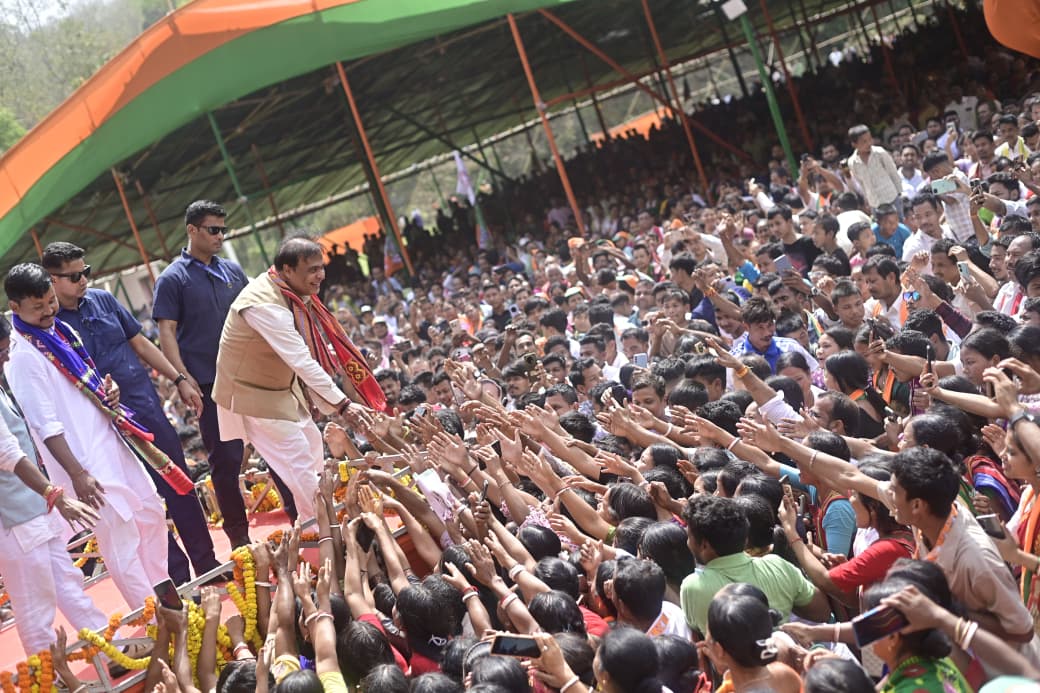
If one believes in Assam chief minister Himanta Biswa Sarma, the ruling National Democratic Alliance is returning to power as the electorates have shown an extraordinary commitment for electoral politics on 9 April 2026 assembly polls. For the single-phase polling, 2.50 crore citizens (including 1.25 crore female voters and 6.4 lakh first-time voters aged 18–19 years) were registered as electorates to elect 126 representatives for the State legislative assembly and they had scored an all time high over 85 percent voters’ turnout. Altogether 722 candidates representing different political parties and independent contenders remain in the fray, where their fate will be decided on 4 May counting day.
Many assembly constituencies in Assam namely Birsing Jarua, Jaleshwar, Srijangram, Mankachar, Golakganj, Laharighat, Chenga, Goalpara East have recorded over 90% polling, whereas urban localities under Kamrup and Kamrup (metropolitan) districts showed a slightly lower turn out (less than 80% in Dimoria, Dispur, Guwahati Central, Jalukbari and New Guwahati seats). Assam used to witness a significant voters’ response in 2016 (84.72%), which replaced the Tarun Gogoi-led Congress government in Dispur (after his third consecutive term as the State chief minister) with a new found alliance led by Bharatiya Janata Party.
With high voters’ participation, the political observers in the region put two completely opposite predictions, where one group is favouring the return of the BJP-led government and the other one has been weighing for the Indian National Congress-led opposition alliance. A sizable population of Assam openly supported the saffron alliance citing the reasons for improved safety-security scenario, sustainable development and impartial welfare initiatives for the entire population. An aggressive campaign by incumbent chief minister Sarma, adding colours to it by subsequent presence of Prime Minister Narendra Modi and Union home minister Amit Shah with other senior BJP leaders in election rallies, is projected to encourage more voters to reach the polling booths.
Moreover, the pertinent issues including anti-influx measures, implementing a number of peace accords, wide ranging development and public welfare initiatives might have attracted the attention of indigenous population. Hence the first group of analysts argued that the larger participation of voters indicated the confidence in the ruling government and so they term it as a pro-incumbency wave. They also pointed out that the mainstream Assamese voters usually show reluctance for participating in any electoral process (compared to the Bangladesh/East Pakistan origin Muslim population living in Assam since the days of independence), but this time they came together to elect their representatives keeping an eye to the future of the next generation.
Additionally, the special review of voters list prior to the polls where the names of non-existent voters (due to death or girls marrying outside the constituency) and an increased awareness among common electorates also contributed in enhancing the voter turnout visibly. The women, many of whom remain beneficiaries of various government-sponsored welfare schemes in the last few years, exceeded their male counterparts. Records indicate that Assam women voters were legging behind the male electorates in 2011 assembly polls, whereas they made it to equal share in 2016 and in the last two elections (2021 and 2026), the female voters slightly surpassed the male contributions.
NDA sets to return to power in Assam !