When the global community observed World Refugee Day on 20 June, a dark reality surfaced from Myanmar where the military-controlled regime in Payitwtaw emerged as a primary actor in creating refugees in their own country. Various global actors claim that over 5.3 million Myanmarese people are now living in distress as the UN High Commissioner for Refugees recently revealed that over a million had already fled to the neighbouring countries namely Bangladesh, Thailand, and India (precisely Manipur and Mizoram). Internally displaced around 3.7 million residents continue to live in border areas with no regular access to food, healthcare and shelter. In fact, chronic poverty now affects nearly 80% of its total 55 million population. The southeast Asian nation’s ruling quasi-democratic regime has simply worsened the scenario with its nationwide brutal campaign against their own civilians.
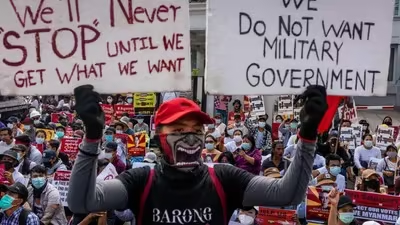
Since the last military coup on 1 February 2021, when the pro-democracy icon Daw Aung San Suu Kyi-led democratically elected government was ousted by the then top military commander Min Aung Hlaing, now becomes the President following a disputed national polls, the situation only deteriorated as hundreds of villages were deserted by the residents to escape the military atrocities generated through relentless airstrikes, burning of houses and even targeted attacks. Hlaing now starts preaching for peace and through his recently concluded official visits to India and China as the civilian head of Myanmar gained some credentials. Prior to Beijing, New Delhi also welcomed Hlaing with red carpets following strategic and business interest (especially Kaladan and tri-national highway projects) in the Land of Golden Pagodas, but the ground reality under the military junta remains the same.
Currently, the regime controls hardly 30 percent of Myanmar’s territory, whereas the ethnic resistance organizations and people’s defense forces run their administrations in 40 % areas putting the rest on constant armed conflicts. More than two years back, the anti-junta forces launched a combined offensive that put the country in a severe political, economic and humanitarian crisis akin to civil war. One of the powerful resistance groups named Arakan Army (AA) today occupies and rules over 70% of the landmass of Rakhine State. The AA fighters continue targeting the junta forces to finally take control over the State capital, Sittwe.
The ongoing conflicts have resulted in heavy casualties across the country, where the United Nations estimated the deaths of over seventy-five thousand people in the last five years. The Rakhine region and central Myanmar continue facing the brunt of military atrocities. The United Nations High Commissioner for Human Rights recently stated that the civilians in both regions faced more brutalities in the recent past. The junta forces after testing defeats against the pro-democracy armed rebels on the battlegrounds often use fighter jets, drones, and paramotors to drop explosives on civilian areas, even targeting schools, hospitals, and refugee camps.
The students remain silent sufferers across the country because of the civil war and prevailing economic crisis. Over six million children and young people in Myanmar will stay out of schools in the 2026-27 academic year. Thus almost half of the country’s estimated school-going children (around 13 million) are now deprived of formal education. The healthcare sector in the country also collapsed as many doctors and health workers were killed in repeated aerial attacks on the clinics. Some important private hospitals were also shut down by the administrations. The media fraternity also faced the most critical period since its independence. With thousands of political prisoners, 215 media workers were targeted in the last five years. According to the Geneva-based global media safety and rights body, Press Emblem Campaign (PEC), nearly 15 journalists are still languishing under detention. The PEC recently disclosed that 97 media outlets were subjected to legal harassment.
The National Unity Government (formed by the elected lawmakers after the coup) recently issued a strong statement asking the international investors in Myanmar to maintain the transparency, accountability and respect to local communities. Functioning as a parallel civilian administration, the NUG asserted that any economic and investment agreements made with the junta authority, under virtual control of coup leader Hlaing, lacked legitimacy and such arrangements may even be subjected to legal, financial, and operational risks.
Probably it will need more time for the dust to settle there.
When Myanmar junta makes millions homeless